
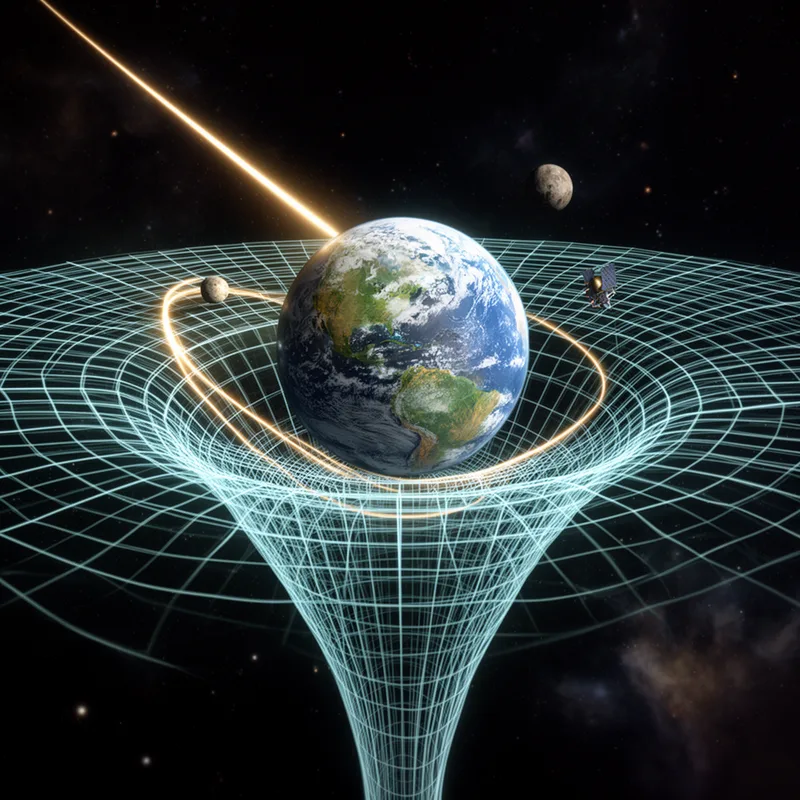
general theory of relativity
 3
6.8
3
6.8

- noun
- /ˈdʒɛnərəl ˈθɪəri əv rɪˈlætɪvɪti/
- Specialized
- One method relies on gravitational lensing, an effect predicted by Albert Einstein's general theory of relativity and first demonstrated by Arthur Eddington during a solar eclipse in 1919.
- Einstein's general theory of relativity
- Albert Einstein's general theory of relativity
- special and general theory of relativity
Loading YouTube…
Watch on YouTubeAnd so space-time is essential for Einstein's theory of relativity, both the special theory and the general theory of relativity.
- And so space-time is essential for Einstein's theory of relativity, both the special theory and the general theory of relativity.
- Einstein didn't even know it, but he first put forth this possibility way back when he first put forth the general theory of relativity.
- One of the books was this, the General Theory of relativity by Einstein.
Examples
-
Einstein's general theory of relativity, introduced in 1915, describes how matter distorts space-time and produces gravity in the process.
Academic text (2001) -
In 1916, Einstein published his general theory of relativity, explaining the relationship between space, time, and gravity.
-
The general theory of relativity has held up startlingly well against all later tests.
Academic text (1991) -
According to the general theory of relativity, a singularity represents a boundary to space and time.
Academic text (1992) -
Nevertheless, binary pulsars are extremely important as laboratories for testing the general theory of relativity.
Academic text (1999) -
Modern physics is divided into two parts: the quantum physics of probability and Einstein's general theory of relativity.
Blog text (25) -
Albert Einstein first predicted the existence of gravitational waves in his general theory of relativity.
Academic text (2001) -
One result predicted by Einstein's general theory of relativity is that gravity bends light.
Academic text (1991) -
The Physics Nobel laureate and astrophysicist Subramanyan Chandrasekhar believed that Einstein's general theory of relativity is the most beautiful creation of human thought.
Academic text (2004) -
According to Albert Einstein's general theory of relativity, space itself is free to do what it likes.
Synonyms
 9
6.7
9
6.7
A scientific theory that says gravity is the bending of space and time by heavy things like stars and planets
 1
8.1
1
8.1
A theory by Albert Einstein that explains gravity as the bending of space and time

Explains gravity as the bending of space and time by heavy objects
How Accurate
- Specialized
3
6.8

- Specialized

 1
4.8
138
6.1
288
4.8
1
4.8
138
6.1
288
4.8
Surface Forms
Morphology
general + theory + of + relativity
The phrase is compositionally formed from 'general' + 'theory' + 'relativity', so a learner who knows those words can infer it refers to a broad theory concerning relativity (i.e., a wide-ranging theory about relativistic effects). However, the detailed scientific content (Einstein's specific claim about gravity as spacetime curvature and the technical distinction from 'special relativity') is specialized and not predictable from the constituent words alone, so the meaning is only partially transparent.
Etymology
General theory of relativity was named by Einstein to show it was a more general version of his earlier 'special theory of relativity'; here general means it covers more situations and relativity shows that measurements can change depending on who is watching. A simple picture is a stretched sheet (space-time) that bends under a heavy ball, and that is why the theory today describes gravity as the bending of space-time.