
general relativity
 9
6.7
9
6.7

- noun
- /ˈdʒɛnərəl rɪˈlætɪvɪti/
- Specialized
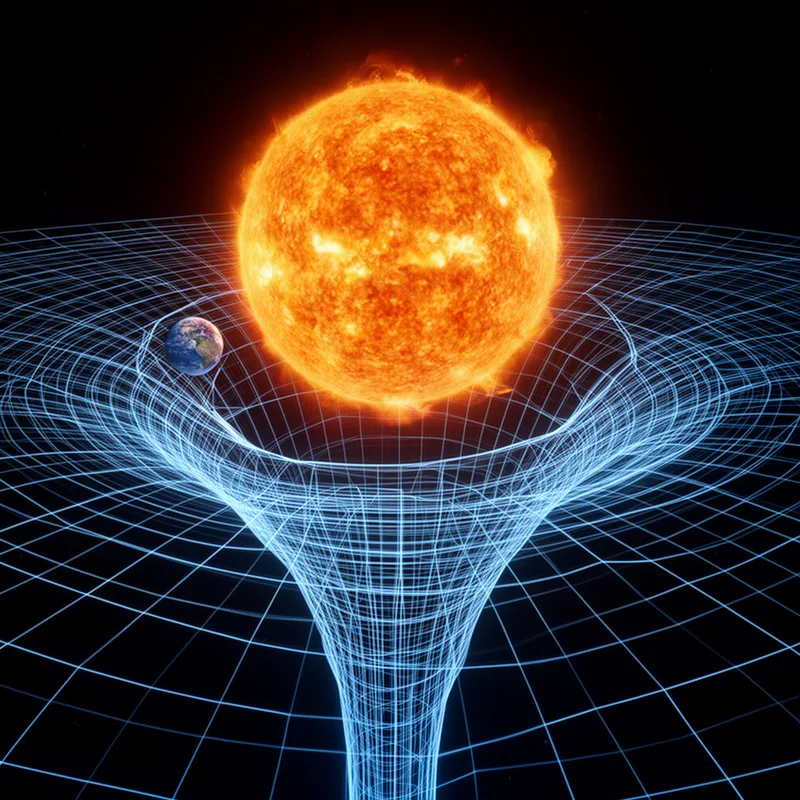
- Einstein's theory of general relativity explains how massive objects curve spacetime, influencing the motion of planets.
- general relativity theory
- predictions of general relativity
- tests of general relativity
Loading YouTube…
Watch on YouTubeBut now we know in advance that general relativity has these limits.
- But now we know in advance that general relativity has these limits.
- Think of general relativity as more or less the theory of the canvas.
- And so those are also, those are based on, on general relativity also, not quantum theory.
- Well, if we have a quantum theory of gravity, I remind you, general relativity is a theory of space and time.
- But right now we have two major frameworks, the Standard Model of particle physics and general relativity.
- Unfortunately, yeah, we know what we are looking for is a deviation from general relativity, because we know this is not the ultimate theory.
- That according to general relativity, is the straight trajectory.
- That's still described by Einstein's general relativity.
- Look, if you start with a universe that obeys the laws of general relativity, but you feel it uniformly.
Examples
-
The measured points lie smack dab on the path laid down by general relativity.
Academic text (2001) -
Now our best theory of gravity is still Einstein's theory of general relativity, which says that that heavy objects, massive things curve space itself.
-
You said that general relativity is the most beautiful theory ever so far.
-
But as I said, general relativity is hard.
-
But now we know in advance that general relativity has these limits.
-
First, though, we review the current status of tests of general relativity.
Academic text (1999) -
Now this is the general relativity description of this expanding space.
-
What's the next big prediction made by general relativity that scientists are testing?
-
Sciama called it the most important contribution to general relativity since the theory was formulated.
Academic text (1991) -
That's what Einstein's general relativity says, is that gravity actually is just the curvature of space.
Synonyms
 3
6.8
3
6.8
A scientific idea that says gravity happens because space and time bend
 1
8.1
1
8.1
A theory by Albert Einstein that explains gravity as the bending of space and time

Explains gravity as the bending of space and time by heavy objects
Surface Forms
Morphology
The phrase is compositionally formed (modifier + noun): knowing 'relativity' as a scientific theory and 'general' as 'broad/extended' lets a learner infer this denotes a broader/extended form of relativity. However, the technical content (that it concerns gravity and curvature of spacetime) and historical/theoretical details are not derivable from the parts alone, so the full meaning is not predictable without prior domain knowledge.
Etymology
General relativity gets its name from two ideas: relativity, the idea that motion can look different to different people, and general, because Einstein made the rule work for all situations, even when gravity is strong. He pictured heavy objects bending space and time like a ball on a stretched sheet so smaller things roll toward the dip. So General relativity means the theory that explains 'gravity' as curved space and time.