
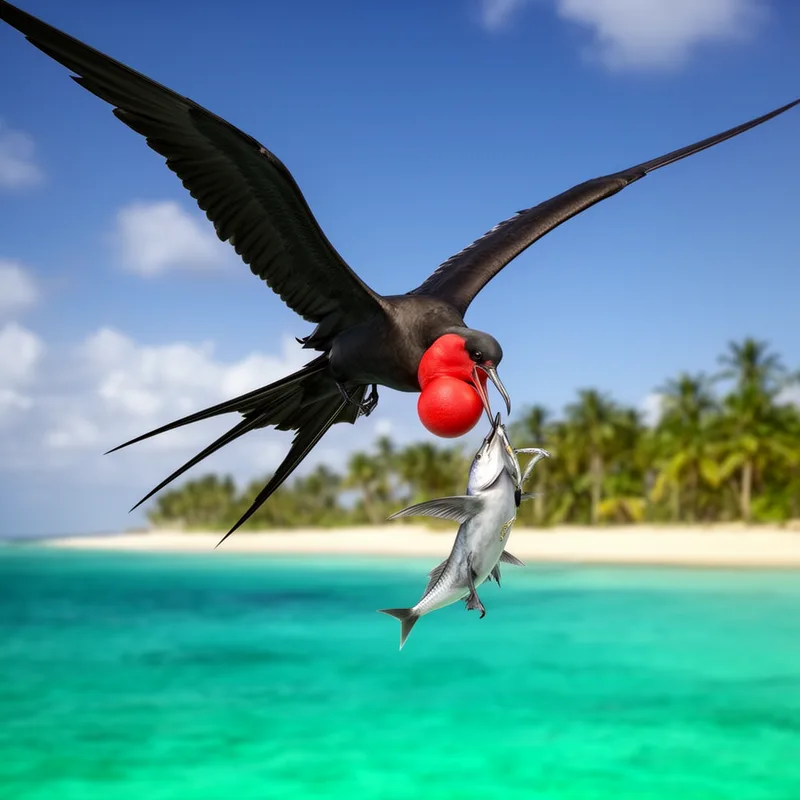
frigate bird
 1
7.8
1
7.8

- noun
- /ˈfrɪɡət bɜrd/
- While sailing near the Galapagos Islands, we were thrilled to see a frigate bird steal a fish from another bird.
- a male frigate bird
- a great frigate bird
- frigate bird flies
Examples
-
The frigate bird is remarkable for its ability to glide for hours without flapping its wings.
-
During courtship, the male frigate bird... inflates to enormous size the red pouch found here.
-
Far above him, great frigate birds circle.
Fiction book (2000) -
You get logs and frigate birds and fish finders and bottles of rum.
-
I float on my back, beyond the breakers, watching the frigate birds circling overhead.
Blog text (15) -
The great frigate bird swoops all around the booby until, panicked, it drops the fish, which plummets toward the sea.
Fiction book (2000) -
Depending on your chosen taxonomy, there are between twenty-seven and thirty-eight extant species of cormorants, all closely related to pelicans, frigate birds, and anhingas.
Academic text (2009) -
Terns and frigate birds on the beach, gannets and gulls on the rocks, noddies and gelinottes in the trees, tropic birds and papangoes in the air.
Fiction book (2001) -
As we hiked along the coast, we spotted several frigate birds soaring gracefully above the ocean waves.
Synonyms
 10
1.9
10
1.9
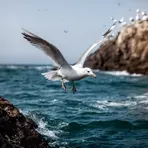
A bird that lives near the sea and often flies over water, like gulls or albatrosses

 1
2.0
1
2.0
A bird that lives near the sea, like a gull
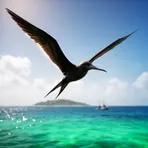
A large sea bird with a long beak, very long wings, and a forked tail that flies over warm seas

A bird that lives near the sea, like gulls or pelicans
How Big

Surface Forms
Morphology
frigate + bird
The element 'bird' makes it clear this is a kind of bird, so part of the meaning (that it is a bird) is immediately recoverable from the constituents. However, 'frigate' is a relatively rare lexical item and does not transparently convey the specific zoological traits or behaviour of the species, so the full referential meaning is not predictable without prior knowledge.
Etymology
Frigate bird may come from a fast ship called a frigate because sailors thought the bird's quick flight and habit of 'stealing' food looked like a ship or a pirate. That's why the name fits a large sea bird that soars above the ocean and often takes food from other birds.