

to fractionate
 1
9.8
1
9.8

- verb
- /ˈfrækʃəˌneɪt/
- Specialized
 :
fraccionar
:
fraccionar
- Next comes Poet's Liberty Project that fractionates the kernel and processes the cobs for cellulosic and process heat, and it gets even better.
It's like you have to fractionate the oppressed all the way down to the level of the individual.
- It's like you have to fractionate the oppressed all the way down to the level of the individual.
- These are highly fractionated food byproducts, not food, and they stimulate the dopamine cascade in the brain.
- Now I feel like those ideas sweep through culture like a raging inferno and can then create all these little fractionated groups.
Examples
-
I suppose you could devise a technique to fractionate naturally occurring water, based on the fact that heavy water is indeed about 10 percent heavier, but you'd have to process an enormous amount of water to separate out the amount you said you found.
Fiction book (2002) -
With these techniques, samples can be fractionated and characterized in a mere portion of the time formerly required.
Academic text (1995) -
The laboratory uses advanced techniques to fractionate the mixture into its individual components.
-
In the oil industry, crude oil is often fractionated using distillation to separate it into useful products.
-
Scientists can fractionate complex mixtures to identify their separate chemical parts.
Synonyms
 680
1.1
680
1.1
To split something into parts or groups
 513
1.3
513
1.3
To break something into two or more parts
 297
1.9
297
1.9
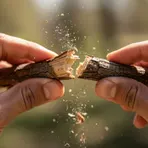
To break into parts or pieces
 47
2.6
47
2.6
To divide something into smaller parts
 36
3.7
36
3.7
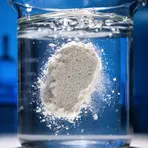
To make something separate into smaller parts by a chemical process
 12
3.5
12
3.5
To divide something into separate parts
 11
5.2
11
5.2
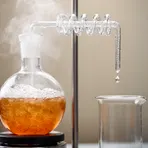
Make a liquid pure by heating it and collecting the cooled steam
 8
4.2
8
4.2
To split something into smaller parts
 7
3.7
7
3.7
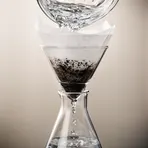
Remove one part from a mixture using a filter or another method
 5
6.3
5
6.3
Pour liquid from one container into another to leave solid bits behind
 3
7.5
3
7.5
To separate something into smaller parts to study it
 1
9.9
1
9.9
To cut or separate something into parts, often by breaking it

To remove solid parts from a liquid or gas using a filter
Antonyms
How Separated
30
4.6

- Specialized
114
6.2
- Specialized
1
9.8
297
1.9
416
1.0
Surface Forms
Morphology
Etymology
Fractionate comes from the same root as fraction and fracture, which mean 'part' and 'break'. So, to fractionate is to 'break' a mixture into parts, which is why it means to separate a mixture into its components.