
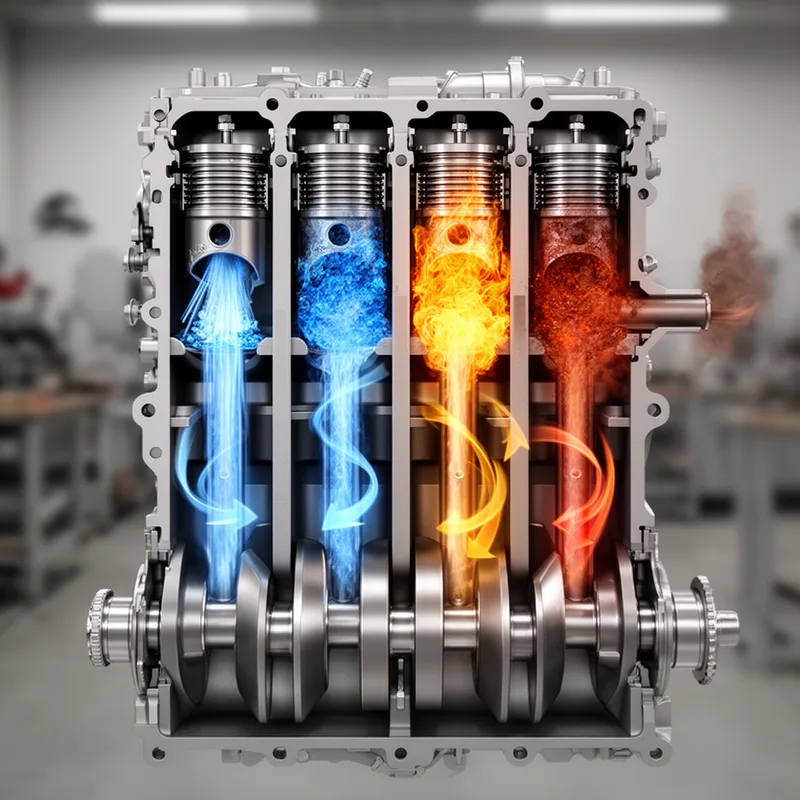
four-stroke engine


 1
4.4
1
4.4
- noun
- /fɔr stroʊk ˈɛnʤɪn/
- Specialized
- Another example would be the study of the combustion engine, where students might first consider the single-stroke engine before moving on to the two-stroke and four-stroke engines.
- hp four-stroke engine
- use four-stroke engines
Examples
-
But moving from two-stroke engines to four-stroke engines, going from one way of working to another takes time.
-
The dry weight of the engine is 120 kilograms (265.2 lbs), about 25 percent less than a conventional six-cylinder, four-stroke engine.
Academic text (2000) -
Many engineers believe that the four-stroke engine is more efficient than its two-stroke counterpart.
-
Most modern motorcycles are powered by four-stroke engines due to their better fuel efficiency.
-
A typical four-stroke engine completes an entire cycle through intake, compression, power, and exhaust strokes.
Synonyms
 11
4.5
11
4.5
A machine that burns fuel inside to make power to move a car or plane

A machine that burns fuel inside and makes power in four piston strokes
Surface Forms
Morphology
four-stroke + engine
The meaning 'an engine with four distinct strokes' is directly compositional from 'four' (number) + 'stroke' (a movement or phase) + 'engine' (machine converting fuel), so a learner who knows the constituent words can infer that the engine operates in four phases. Although somewhat technical, the construction is transparent and parallels expressions in many languages (e.g. French 'moteur à quatre temps'), making it accessible to B1 learners who know the parts.
Etymology
Four-stroke engine comes from the idea of four separate strokes or moves inside the engine: 'intake', 'compression', 'power', and 'exhaust'. So the name tells you it finishes a full cycle in four moves, and that is how it produces power today.