
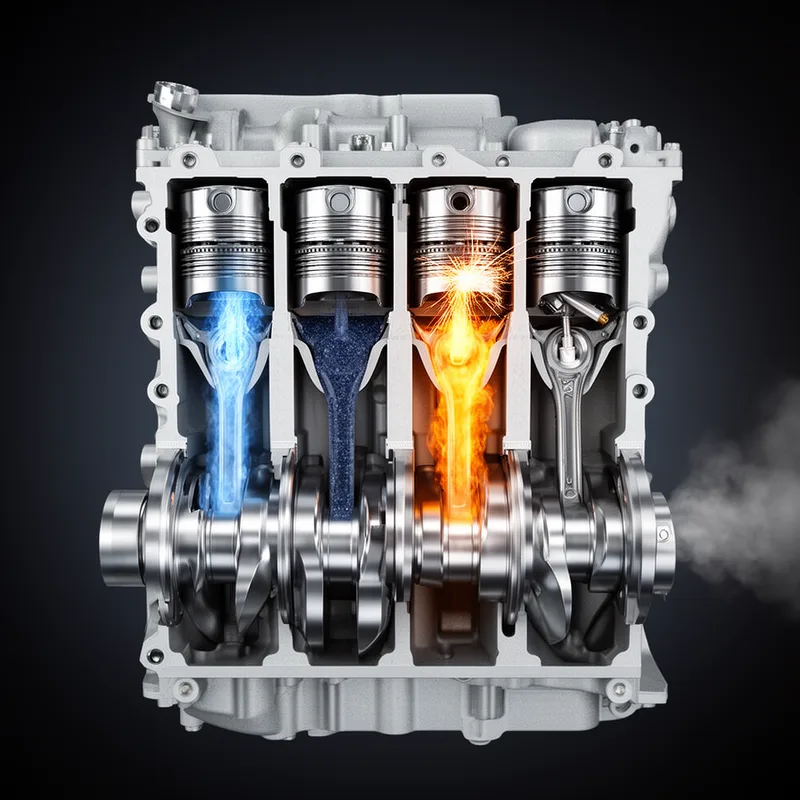
four-stroke internal-combustion engine
- noun
- /fɔr stroʊk ˌɪntɜrnəl kəmˈbʌsʧən ˈɛnʤɪn/
- Specialized
- The four-stroke internal-combustion engine powers most modern cars.
Examples
-
The majority of modern cars use a four-stroke internal-combustion engine for improved fuel efficiency.
-
Many motorcycle manufacturers use a four-stroke internal-combustion engine.
-
Advancements in the four-stroke internal-combustion engine design have helped reduce vehicle emissions.
-
He studied how the pistons move during each phase of the four-stroke internal-combustion engine cycle.
-
Advancements in the four-stroke internal-combustion engine design have helped reduce vehicle emissions.
-
The majority of modern cars use a four-stroke internal-combustion engine for improved fuel efficiency.
-
He studied how the pistons move during each phase of the four-stroke internal-combustion engine cycle.
Synonyms

 11
4.5
11
4.5

A machine that burns fuel inside to make power to move a car or plane


 1
4.4
1
4.4
A machine that makes power using four piston movements in one cycle
Surface Forms
Morphology
four-stroke + internal-combustion + engine
The phrase is transparently compositional: 'four-stroke' signals a four-part piston cycle and 'internal-combustion' signals burning inside the machine, combined with 'engine' (a machine that converts fuel to mechanical energy). These component meanings make the overall concept (an engine that uses internal combustion in a four-stroke cycle) directly inferable to learners who know the constituent words and basic mechanical terms, and the modifier+noun pattern is cross-linguistically common.
Etymology
The noun four-stroke internal-combustion engine is named for the four movements of a piston inside the engine: the intake, compression, power, and exhaust strokes. So the name tells you the engine completes one full 'power cycle' in four 'strokes', when fuel is burned to make power.