

forest tent caterpillar
- noun
- /ˈfɔrɪst tɛnt ˈkætərˌpɪlər/
- Specialized
- A distinctive blue stripe helps to identify the forest tent caterpillar from other moth larvae.
Examples
-
The forest tent caterpillar can devastate entire stands of aspen and oak trees if left unchecked.
-
Every spring, swarms of forest tent caterpillars appear in the local woodlands, causing concern among foresters.
-
The forest tent caterpillar is often found in large groups.
-
Many forest tent caterpillars can harm trees rapidly.
-
Forest tent caterpillars can quickly defoliate entire trees, causing significant damage to forest tent caterpillars.
-
During spring, forest tent caterpillars are often seen crawling in large groups on oak trees.
-
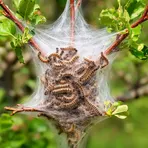
The forest tent caterpillar spins a web that resembles a carpet, which can be found on tree branches.
Synonyms


 1
6.7
1
6.7
A caterpillar that lives in groups inside a silk web on tree branches

A North American moth whose caterpillars live together in trees, spin silk mats, and eat leaves, sometimes harming forests
Surface Forms
Morphology
forest + tent + caterpillar
The phrase is fully compositional: the head noun 'caterpillar' is modified by 'tent' and 'forest', so a learner who knows the words can infer it refers to a caterpillar associated with tent-like webs found in forests. Specific biological details (species name, pest status, or exact web structure) are not predictable, but the core denotation is directly derivable from the constituents.
Etymology
Forest tent caterpillar: The name forest tent caterpillar comes from young caterpillars living in groups and spinning a silk 'web' on tree branches that looks like a small tent or a 'carpet'. So the name helps you picture these group-living caterpillars that can be a serious 'pest' of forest trees.