

foreign legion


 1
6.7
1
6.7
- noun
- /ˈfɔrɪn ˈliːdʒən/
- Many young men have joined the foreign legion in search of adventure and a fresh start.
Loading YouTube…
Watch on YouTubeHe takes up drinking and joins the Klatchian Foreign Legion.
- He takes up drinking and joins the Klatchian Foreign Legion.
- Everyone's pretty good but it the lead French Foreign Legion is a one stop shop for France.
- They obviously have that Foreign Legion thing going on and you're getting all kinds of people joining that.
Examples
-
The alternative is to copy the foreign legion model, with units that combine U.S. officers and nonnative volunteers who have renounced their national allegiance, perhaps attracted by the offer of U.S. citizenship after a given term of service.
Academic text (1994) -
They obviously have that Foreign Legion thing going on and you're getting all kinds of people joining that.
-
The foreign legion is our home, gentlemen!
-
There's a foreign legion of women too.
-
As a result, the elite units of the French military, such as the paratroopers and the foreign legion, quickly became a haven for an unsavory collection of thugs and psychopaths.
Academic text (2004) -
The foreign legion is known for accepting volunteers from various countries, uniting them for a common cause.
-
Training in the foreign legion can be extremely challenging, as recruits must adapt to a rigorous military lifestyle.
Synonyms
 2
5.6
2
5.6
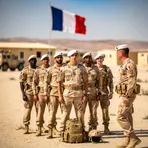
Part of the French army made of foreign volunteers who serve abroad
Surface Forms
Morphology
The meaning is directly derivable from 'foreign' (from other countries) + 'legion' (a large military unit), so a learner who knows both words can infer 'a military unit made up of foreigners'. Although there is a specific famous institution (the French Foreign Legion), the composition is transparent and follows normal noun + modifier logic found across languages.
Etymology
Foreign legion shows a simple picture: foreign means people from other countries and legion means a large group of soldiers. It began as a French unit that took 'volunteers' from many places, so today the phrase means 'a military unit made of soldiers who are not from the country they serve'.