

forebear
 12
8.1
12
8.1

- noun
- /ˈfɔrˌbɛr/
- My ancestors, or forebears, traveled across the ocean to start a new life in America.
- nineteenth-century forebears
- experience of their forebears
Loading YouTube…
Watch on YouTubeToday, most citizens working lives involve shorter hours and fewer life threatening hazards than our forebears faced.
- Today, most citizens working lives involve shorter hours and fewer life threatening hazards than our forebears faced.
- And I think we are wrong to think ourselves, in some objective sense, the moral superiors of our forebears.
- If we go back to our our, our human forebears, but that doesn't mean that every family or village ate that way at every moment in history.
Examples
-
Americans today are taxed at levels most of our forebears would have considered unthinkable.
Blog text (16) -
Today, most citizens working lives involve shorter hours and fewer life threatening hazards than our forebears faced.
-
Our scientific forebears, you know, have been working on this for a long time.
-
Neither have their forebears for two generations.
-
What I have done was passed on to me from my forebears, eh?
Fiction book (1991) -
for which our forebears fought are still at issue around the globe.
-
People weren't identified by the countries of their forebears, not exactly.
Fiction book (1999) -
Be buried in the graveyard behind the little mission church beside my forebears.
Fiction book (1999) -
Our colonial forebears understood the way feudal societies worked; for the most part, we don't.
Academic text (2011) -
Auel imagines our Ice Age forebears listening with rapt attention to everything from current gossip to ancient legend.
Academic text (2002)
Synonyms
 419
2.4
419
2.4
A person in your family who lived long ago before your grandparents
 35
5.1
35
5.1
A person from older generations who helped start your family or its traditions
 12
8.2
12
8.2
An early ancestor who starts a family line or idea
 2
8.6
2
8.6
A person in your family from past generations
 1
8.4
1
8.4
A woman from an earlier generation who starts a family or tradition


 1
7.9
1
7.9
A person in your family who lived many generations before you
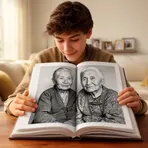 1
9.3
1
9.3
A person in your family from long ago, like a grandparent

An early relative in the direct family line, like a great-grandparent
How Distant

Surface Forms
Morphology
Etymology
Forebear comes from fore- meaning 'before' (as in forecast) and the rest points to a person who lived earlier. So a forebear is an ancestor, a family member who lived before you.