
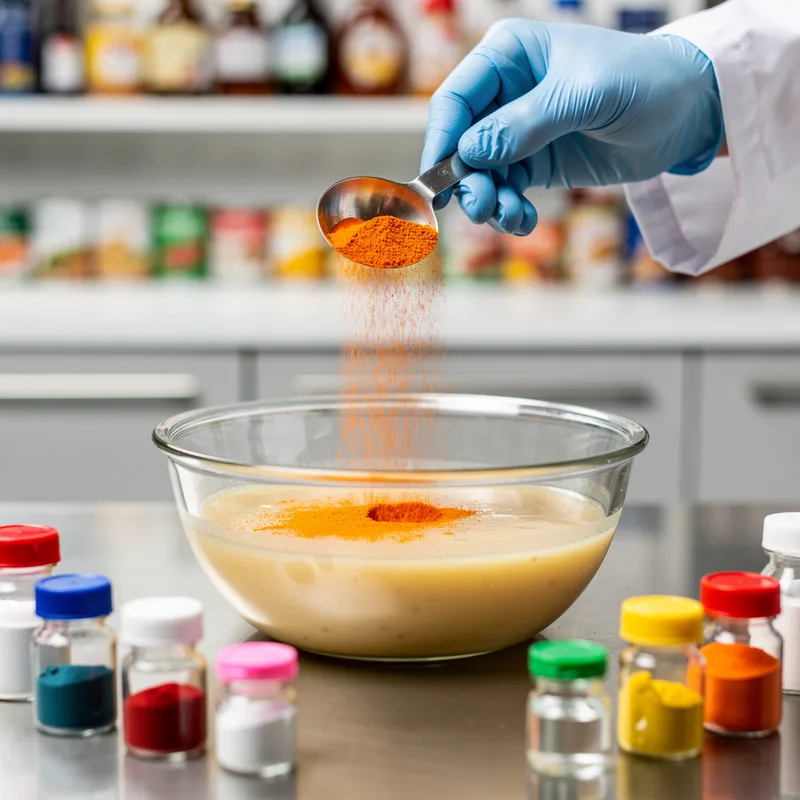
food additive
 5
3.2
5
3.2

- noun
- /fuːd ˈædɪtɪv/
- Specialized
 :
aditivo alimentario
:
aditivo alimentario
- Some consumers are concerned about the health effects of certain food additives in processed foods.
- food additives and preservatives
- antibiotics used as food additives
- commonly used as food additives
But the biggest bulk of them comes from food additives.
- But the biggest bulk of them comes from food additives.
Examples
-
According to the CDC (2002), food additives such as sorbitol and fructose can also cause acute diarrhea.
Academic text (2004) -
Many food manufacturers use food additives to enhance the flavor of their products.
-
Although effective, these chemicals do not satisfy the necessary requirements as approved food additives.
Academic text (1993) -
Food additives are commonly used to extend the shelf life of meat products.
Academic text (2005) -
And a Los Angeles group has petitioned the Food and Drug Administration... to outlaw all food additives.
-
New food additives, which are somewhat controversial, allow trout to be colored so that their flesh looks like salmon.
Academic text (1990) -
Thus, for this category of food additives, the law shifts the burden of proof to the petitioning firm(s).
Academic text (1996) -
In all, their tantalizing, all-natural new foods and innovative food additives are intended to help us prevent unwanted weight gain yet still enjoy what we eat.
Academic text (2006) -
Some of these studies have focused on the question of how the subtherapeutic use of a particular antibiotic as a food additive for livestock affects drug resistance in bacteria in the animals and in those who come into contact with those animals.
Academic text (2000) -
In that case, the agency banned acrylonitrile on the grounds that it counts as a "food additive" because acrylonitrile migrates in small amounts from bottles into the drinks they contain.
Academic text (2001)
Synonyms
 38
3.7
38
3.7
A small ingredient added to food or fuel that helps it last longer
 30
2.0
30
2.0
A substance added to food or drink to make it taste sweeter
 24
3.7
24
3.7
A substance added to food or wood to stop decay
 16
1.1
16
1.1
A thing added to food or drink to give it a certain taste
 14
1.4
14
1.4
A liquid or powder that people add to food to give it color


 1
2.3
1
2.3
A thing added to food or drink to change how it looks

An ingredient added to food or drink to give it a particular taste

An ingredient like salt or pepper that makes food taste better

Something added to food or drink to make it sweeter

An ingredient added to food to stop it going bad
How Effective
24
3.7

- Specialized
36
3.9
- Specialized
5
3.2
- US
16
1.1
- US
26
1.0
Surface Forms
Morphology
The meaning is directly and compositionally derived from 'food' (what is eaten) + 'additive' (a substance added to improve or preserve), so a learner who knows both words can infer it refers to a substance added to food. This is a productive noun‑noun compound pattern found across languages (e.g., aditivo alimentario, additif alimentaire), making it readily comprehensible to a B1 learner.
Etymology
Food additive comes from the simple idea of something added to food. A small additive, like salt, sugar, or a preservative, is put in to make food taste better, look brighter, or stay fresh, so the term means 'a substance added to improve flavor, appearance, or shelf-life'.