
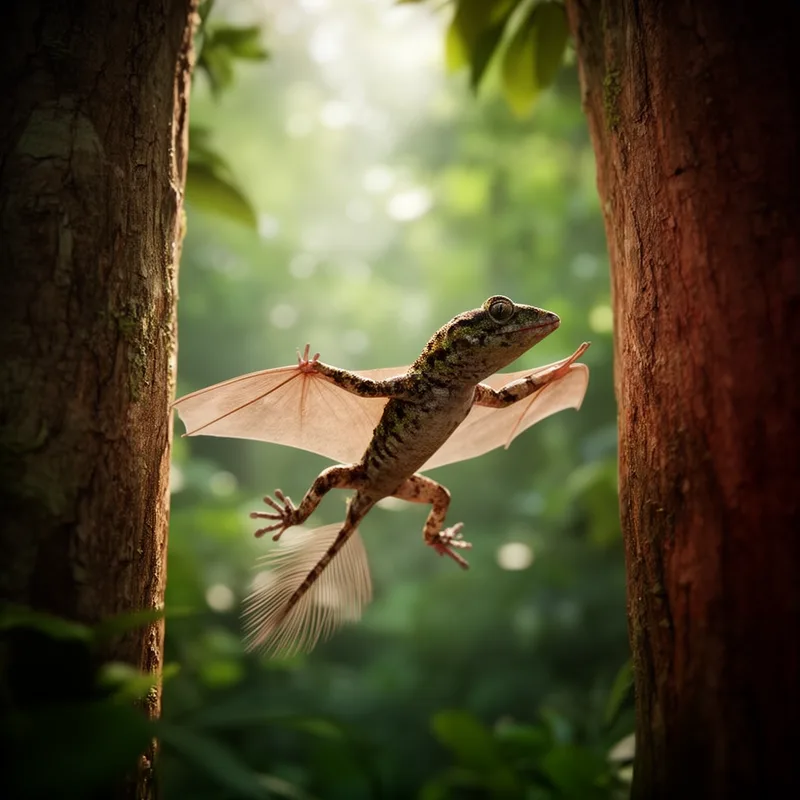
flying gecko
- noun
- /ˈflaɪɪŋ ˈɡɛkoʊ/
- Philippine
- The flying gecko can leap from tree to tree by spreading its flaps of skin.
Examples
-
The flying gecko glided gracefully between the trees.
-
Did you see the flying gecko in the garden?
-
Researchers observed a flying gecko gliding gracefully through the rainforest.
-
Unlike other lizards, the flying gecko uses its unique adaptations to cover long horizontal distances.
-
Researchers observed a flying gecko gliding gracefully through the rainforest.
-
The flying gecko can leap from tree to tree by spreading its flaps of skin.
-
Unlike other lizards, the flying gecko uses its unique adaptations to cover long horizontal distances.
Synonyms

 17
2.9
17
2.9

A small tropical lizard that comes out at night to eat insects and often clings to walls

A gecko with skin flaps that lets it glide between trees

A small lizard with skin flaps on its sides, legs, and tail that let it glide short distances
How Far
- Philippine

- Indian
1
7.4
- Indian
- Philippine

 1
3.8
1
3.8
Surface Forms
Morphology
The noun phrase is directly descriptive: 'flying' (able to fly or glide) combined with 'gecko' yields a gecko that flies or glides. A B1 learner who knows 'fly' and 'gecko' can reliably infer this referent because the adjective+noun composition follows normal, cross-linguistically common compounding patterns.
Etymology
Flying gecko shows a clear picture: a gecko with wide flaps of skin that it spreads like tiny wings to glide from tree to tree. That's why the word flying is used — it means 'a gecko that can glide short distances between trees'.