

flying gurnard
- noun
- The flying gurnard spread its enormous fins as it glided gracefully along the seabed.
Examples
-
Unlike searobins, the flying gurnard uses its fanlike fins to move elegantly underwater.
-
While snorkeling in the Caribbean, we spotted a colorful flying gurnard resting on the sand.
-
The flying gurnard glided gracefully through the water.
-
Have you ever seen a flying gurnard in the wild?
-
The flying gurnard spread its large, colorful fins and glided effortlessly through the clear blue waters.
-
While snorkeling at the coral reef, I was amazed to see a flying gurnard using its fan-shaped fins to glide elegantly just beneath the surface.
-
As we floated above the sandy seabed, a beautiful flying gurnard appeared, showcasing its impressive fins while maneuvering gracefully.
Synonyms
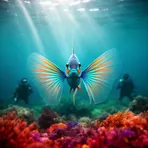
A fish from warm seas with large fan-shaped side fins that glides underwater

A sea fish with large wing-like fins on its sides

A group of sea fish called flying gurnards with large wing-like side fins
How Far
- Philippine

- Indian
- Indian
 1
7.4
1
7.4


 1
3.8
1
3.8
- Philippine
Surface Forms
Morphology
The modifier 'flying' straightforwardly describes the gurnard as having a flying or gliding quality, so a learner who knows 'flying' and 'gurnard' can reasonably infer it is a kind of fish that appears to fly or glide (similar to 'flying fish'). This compositional, descriptive relationship is predictable and cross-linguistically common, so the meaning is transparent to a B1 learner.
Etymology
Flying gurnard gets its name from the huge, fan-shaped side fins it opens like wings. When the fish spreads these fins and glides along the sea floor it looks as if it is 'flying' underwater, so the name links its wing-like fins to that gliding motion.