

flowering plant
 4
2.0
4
2.0

- noun
- /ˈflaʊərɪŋ plænt/
- In spring, many gardeners plant flowering plants to brighten up their yards.
- flowering plant species
- seeds of flowering plants
- percent of all flowering plants
Loading YouTube…
Watch on YouTubeMany flowering plants have the flower pattern in the ultraviolet to attract the insects.
- Many flowering plants have the flower pattern in the ultraviolet to attract the insects.
- And those planets had like more sophisticated vein systems and they were moving beyond spores to seeded plants, etcetera and flowering plants.
- Not with palms and ferns, but palms, ferns and flowering trees, deciduous trees, flowering plants, wildflowers.
Examples
-
All flowering plants rely on a shared set of fundamental gene functions to build their blooms.
Academic text (2006) -
Sweet fern, despite its name and fern-like foliage, is actually a flowering plant in the wax myrtle family.
Academic text (2011) -
There are groups covering both general nature and flowering plants.
Academic text (2001) -
And the flowering plants, they really cheer the place up.
-
All angiosperms are flowering plants, some of which are woody and some of those are trees.
-
The nandina is a species of flowering plant native to Eastern Asia.
-
Many flowering plants have the flower pattern in the ultraviolet to attract the insects.
-
Vegetation, including twenty-six species of flowering plants, once again carpeted the island.
Academic text (1996) -
There are a lot of flowering plants, and each species makes its own distinctive-looking pollen grain.
Academic text (1994) -
Seagrasses are submerged aquatic flowering plants that are not directly related to terrestrial grasses.
Academic text (2012)
Synonyms
 ∞
1.0
∞
1.0
Part of a plant that is often colorful and makes seeds
 1
8.5
1
8.5
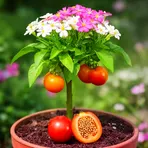
A plant that makes flowers and has seeds inside a fruit
How Ornamental
1
4.8
 1
1.0
1
1.0
- Specialized
1
4.7
4
2.0
187
1.0
Surface Forms
Morphology
The phrase is a straightforward adjective+noun composition: 'flowering' (bearing flowers) + 'plant' (a plant) yields the literal meaning 'a plant that produces flowers.' This direct, compositional pattern is common across languages and follows standard English morphology, so a B1 learner who knows both words will readily understand it.
Etymology
The noun flowering plant is a simple name for a plant that is flowering, so it has flowers. That's why it means a plant that 'produces flowers' and keeps its seeds inside a fruit.