
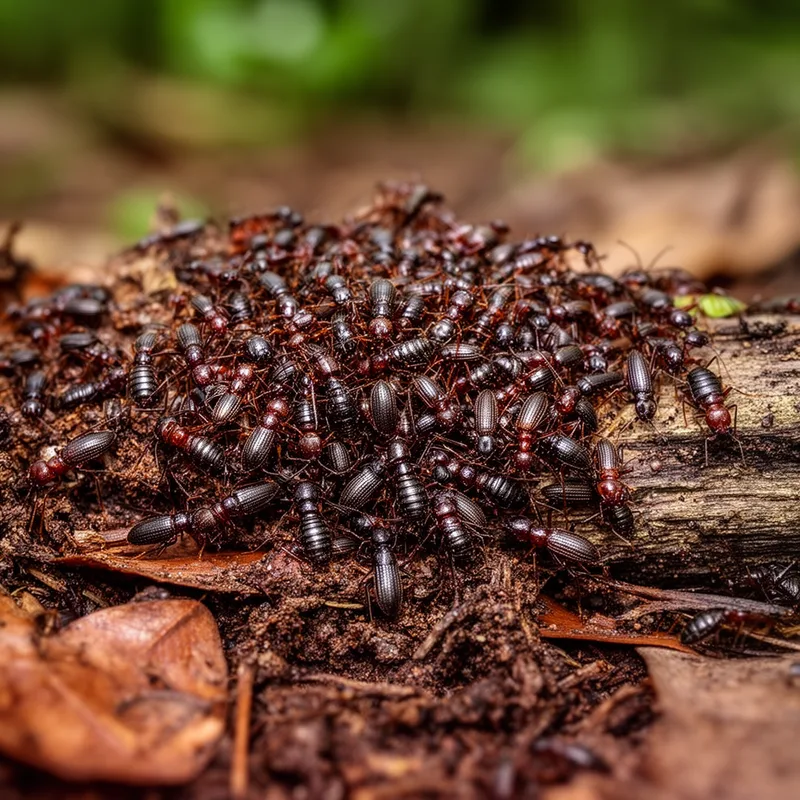
family Staphylinidae


 1
9.2
- noun
- /ˈfæmɪli ˌstæfəlɪˈniːdeɪ/
- Specialized
- The family Staphylinidae includes over 60,000 species of rove beetles worldwide.
Examples
-
Several members of the family Staphylinidae play important roles in natural pest control.
-
Entomologists often collect specimens from the family Staphylinidae when studying decaying organic matter.
-
The family Staphylinidae includes many species of rove beetles.
-
The family Staphylinidae is known for its predatory behavior.
-
Entomologists often collect specimens from the family Staphylinidae, which are crucial for studying the decomposition of organic matter.
-
Members of the family Staphylinidae are vital for maintaining ecosystem balance through their pest control abilities.
-
The family Staphylinidae is noteworthy for containing over 60,000 species that exhibit diverse forms and behaviors.
Synonyms
 1
9.9
A large family of beetles with short wing covers and a flexible back part of the body
Surface Forms
Morphology
family + Staphylinidae
This phrase is compositionally built from the noun 'family' (a scientific grouping) plus a taxonomic name; its meaning — 'the taxonomic family called Staphylinidae' — is directly derivable from the constituents. The taxonomic construction (family + proper Latin name) is cross-linguistically regular, so a B1 learner who knows 'family' and recognizes a capitalized scientific name will understand it denotes a biological family, even if they do not know which organisms that family contains.
Etymology
Family Staphylinidae is the scientific name for the 'rove beetles', a very large group of small, active beetles. Because they have very short wing covers, their long bodies stick out and they quickly 'rove' through leaves and rotting matter, so the name refers to this big family of small, fast beetles with short wing covers.