
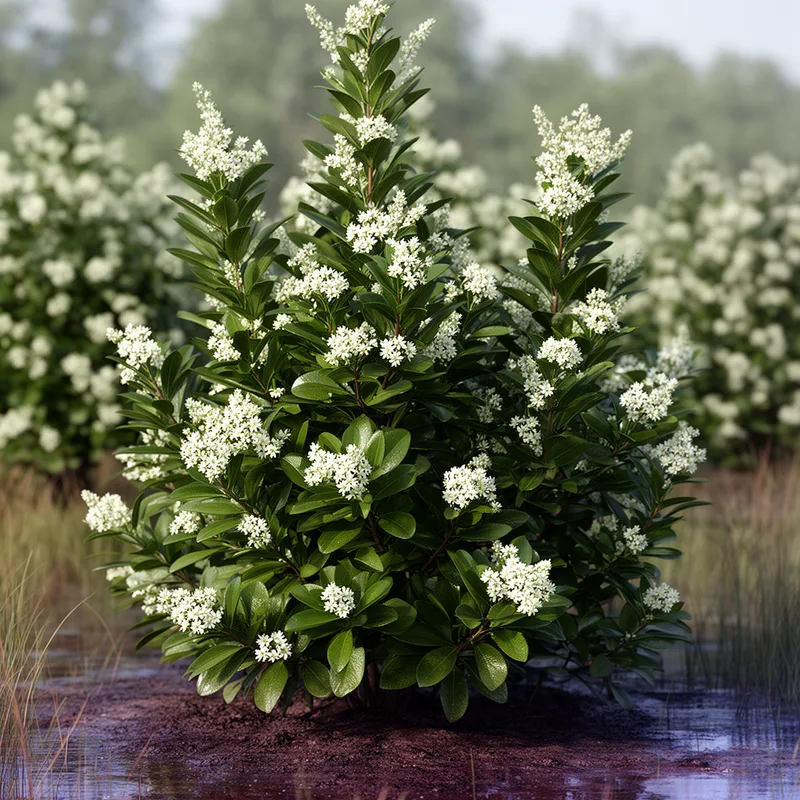
family Cyrilliaceae
- noun
- /ˈfæmɪli sɪrɪliˈeɪsiˌi/
- Specialized
- The family Cyrilliaceae consists of shrubs and trees that are known for their leathery leaves and clusters of white flowers.
Examples
-
The family Cyrilliaceae includes several evergreen shrubs native to the southeastern United States.
-
Plants in the family Cyrilliaceae often thrive in wetland environments.
-
Botanists have reclassified some species, moving them into the family Cyrilliaceae.
-
The family Cyrilliaceae includes several species of shrubs.
-
Many plants in the family Cyrilliaceae thrive in wet environments.
-
Many species within the family Cyrilliaceae are adapted to live in wetland ecosystems, showcasing their resilience.
-
The family Cyrilliaceae features genera such as Cyrilla and Cliftonia, which are commonly found in the southeastern United States.
Synonyms

A family of shrubs and trees with thick shiny leaves and small white flowers

A group of shrubs and trees with leathery leaves and small white flowers

A group of evergreen shrubs and trees with thick leaves and small white flowers
Surface Forms
Morphology
This noun phrase is a straightforward taxonomic composition: 'family' + a taxon name, which yields the meaning 'the family called Cyrilliaceae'. The construction is compositional and cross-linguistically common in scientific naming, so a learner who knows both constituents (and that Cyrilliaceae is a plant-group name) can derive the meaning.
Etymology
Family Cyrilliaceae may come from the main plant genus Cyrilla plus the family ending -aceae. Cyrilla was likely named for an 18th-century naturalist named Cirillo, so the family name simply shows a group of related shrubs and trees.

