

eye socket
 14
3.5
14
3.5

- noun
- /aɪ ˈsɑkɪt/
- Specialized
- The artist painted a haunting portrait that emphasized the deep shadows of the eye socket.
Loading YouTube…
Watch on YouTubeAs I was sticking my thumb down, one of their eye sockets got cut.
- As I was sticking my thumb down, one of their eye sockets got cut.
- It was like some kind of a, like a structure that had eye sockets and nose and a mouth.
- We'll also do up here 'cause I think my whole eye socket is just a little black.
- Well, who has a singular eye socket.
Examples
-
His face appeared to have two gaping eye sockets, like those of a fleshless skull.
Fiction book (1992) -
The sculptor had indicated sight by leaving the eye sockets empty, even in the horses.
Fiction book (1996) -
You can see the eye sockets there.
-
It's going to be entirely in a circular kind of shape around the eye socket area.
-
Just dripping blood from his eye sockets.
-
A broken cheekbone and a fractured eye socket.
-
The position of the orbits (eye sockets) also varies greatly among Eocene cetaceans.
Academic text (2001) -
His tall, bony frame, pitted cheeks, and hollow eye sockets reminded her too much of a coyote.
Fiction book (1995) -
The surgeon carefully examined the damaged eye socket to plan the reconstruction.
-
After the accident, she had swelling around her eye socket that required medical attention.
Synonyms
 34
6.0
34
6.0
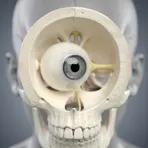
A hollow in a bone where an eye or tooth sits
 5
8.1
5
8.1
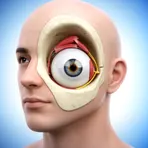
A bony hollow in the skull that holds and protects the eye

 1
6.8
1
6.8
A bony socket in the skull that holds and protects the eye

A bony space in the skull that holds and protects the eye
Surface Forms
Morphology
The noun is directly compositional: 'eye' (the organ) plus 'socket' (a hollow or cavity where something sits) yields the bony cavity that holds the eyeball. This anatomical combination is cross-linguistically common and follows straightforward noun + noun composition, so a B1 learner who knows both words should understand the meaning.
Etymology
Eye socket is a simple picture: the eye sits in a bony socket, a hollow in the skull, so the phrase means the 'bony cavity' that holds the eyeball.