
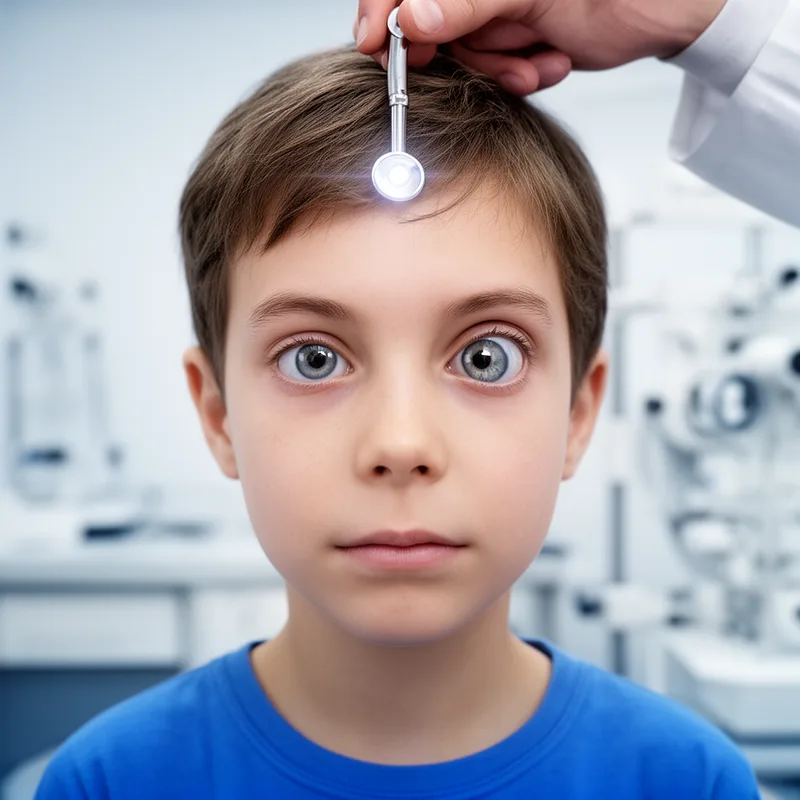
exotropia
- noun
- /ˌɛkstrəˈtoʊpiə/
- Specialized
 :
exotropía
:
exotropía
- Her doctor diagnosed her with exotropia after noticing her right eye turned outward.
Examples
-
The optometrist explained that exotropia causes one eye to drift outward when a person is tired.
-
Surgery is sometimes required to correct severe cases of exotropia.
-
Children with exotropia may have trouble focusing on objects straight ahead.
-
The doctor diagnosed her with exotropia at a young age.
-
Many children with exotropia may require surgery.
-
Children with exotropia often struggle to keep both eyes focused on the same point.
-
In some cases, the only effective treatment for exotropia is corrective eye surgery.
Synonyms

 1
9.8
1
9.8

A problem in which one or both eyes do not point the same way


 1
9.9
1
9.9
One or both eyes point outward instead of looking straight

One or both eyes turn outward away from the nose
Antonyms
Surface Forms
Morphology
exotropia = tropia (semi-transparent) = exo + trop + ia
The prefix 'exo-' signals 'outward' clearly, but 'tropia' is a specialized medical combining form meaning 'turning' that many learners will not know, so the term is only partly derivable.
Etymology
Exotropia comes from two parts: exo- meaning 'outside', like in exoskeleton, and -tropia meaning 'turning'. So exotropia is when one or both eyes 'turn' outward.