
ethmoid


 1
9.9
1
9.9
- noun
- /ˈɛθmɔɪd/
- Specialized
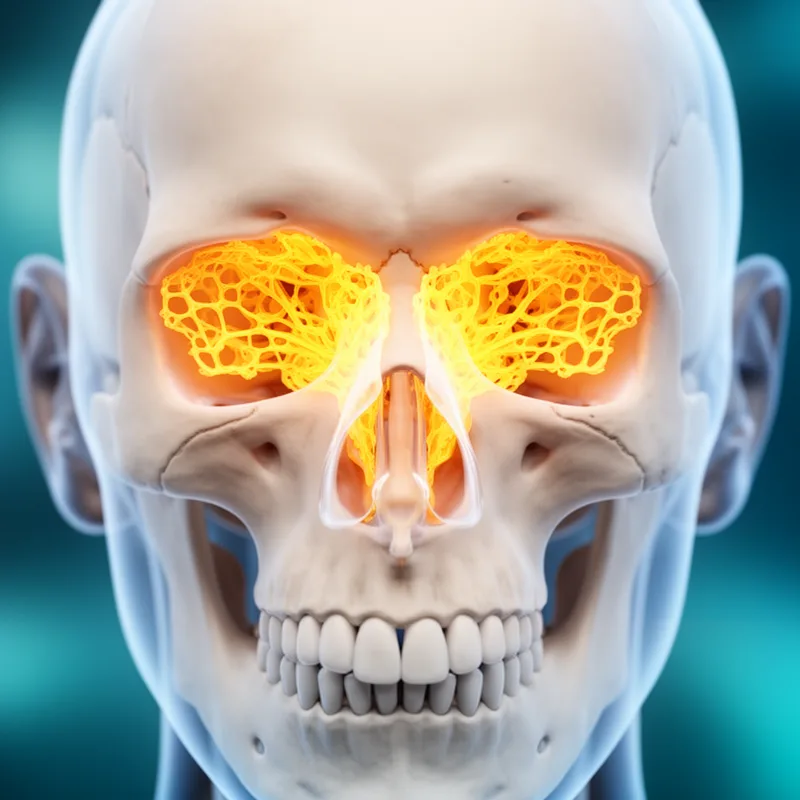
- The ethmoid bone helps support the nasal cavity and provides structure between the eyes.
- ethmoid sinus
- ethmoid bulla
- ethmoid bone
Examples
-
The mass also involved the right ethmoid sinuses and the orbit, and it extended intracranially into the frontal lobe.
Academic text (2002) -
The right ethmoid sinus was also invaded, so a total ethmoidectomy and sphenoidectomy were performed.
Academic text (2008) -
The number of posterior ethmoid cells varies between one and five.
Academic text (2008) -
Note that most had bilateral ethmoid and maxillary management and partial middle turbinectomies.
Academic text (1994) -
After the lesion was completely removed, the walls of the ethmoid bulla were resected.
Academic text (2006) -
The most common specific site of origin is the nasal cavity, followed by the ethmoid sinuses.
Academic text (2009) -
Loughran et al. presented a case of a primary chordoma of the ethmoid sinus.
Academic text (2005) -
In our patient, however, the tumor appeared to have originated in the ethmoid sinus and then spread to the intracranial cavity.
Academic text (2006) -
The anterior and posterior ethmoid arteries supply the septum from above.
Academic text (2007) -
Other reports have looked at the NSA as a result or complication of ethmoid and/or sphenoid sinusitis.
Academic text (2009)
Synonyms
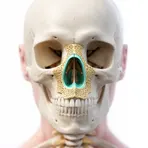
A light spongy bone at the skull base that helps form the eye sockets and the inside of the nose
Compounds
- Specialized
A light spongy bone at the skull base that helps form the eye sockets and the inside of the nose
Surface Forms
Morphology
ethmoid = ethmo + oid
The root 'ethmo-' is a specialized combining form (not a standalone English word) meaning 'sieve-like', so the anatomical sense is not transparently derivable by a typical learner from its parts.
Etymology
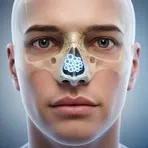
The word ethmoid comes from Greek ethmos, meaning 'sieve', and the ending -oid, meaning 'like'. The bone is full of many small holes so it is 'sieve-like', which is why it is a light, spongy bone between the eyes that helps form the nose area.