
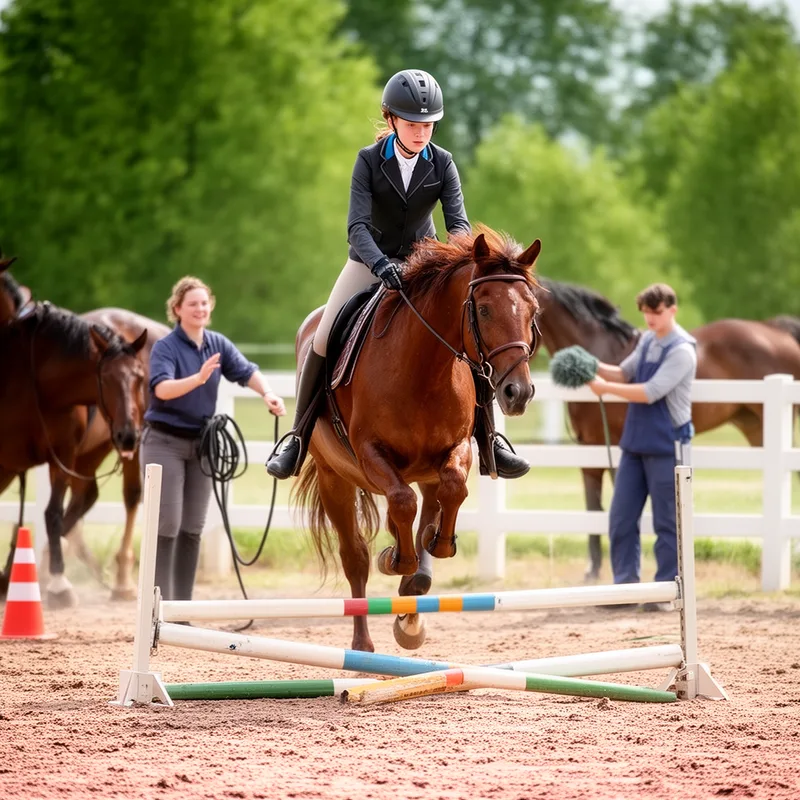
equestrianism
- noun
- /ɪˈkwɛstriənɪzəm/
- Equestrianism requires dedication, as riders must train both themselves and their horses.
Loading YouTube…
Watch on YouTubeThus it was an adjunct military art, a peacetime discipline akin to fencing and equestrianism.
- Thus it was an adjunct military art, a peacetime discipline akin to fencing and equestrianism.
Examples
-
At 16, he moved with his father, now a marquis, to Paris, where he was educated in classical philosophy, equestrianism, and swordsmanship.
Blog text (14) -
Many young people are drawn to equestrianism because of their love for horses.
-
She excelled in equestrianism, winning several competitions for her riding skills.
Synonyms
 97
1.0
97
1.0

Sitting on and controlling a horse while it moves
 23
2.7
23
2.7
An activity of sitting on a horse while it moves for sport or pleasure
 3
5.9
3
5.9
Skill in riding, handling, and training horses
 1
9.9
1
9.9
A skill for riding a horse, often as a sport
Surface Forms
Morphology
equestrianism = equestrian (transparent) = equestrian + ism
The noun is formed by the regular suffix '-ism' from 'equestrian' to mean the practice or system related to horse riding, a derivation predictable to learners who know 'equestrian'.
Etymology
The word equestrianism comes from the Latin roots eques ('horseman') and equus ('horse'), so think of a rider on a horse. That's why equestrianism means the skill and sport of riding, training, and caring for horses.