
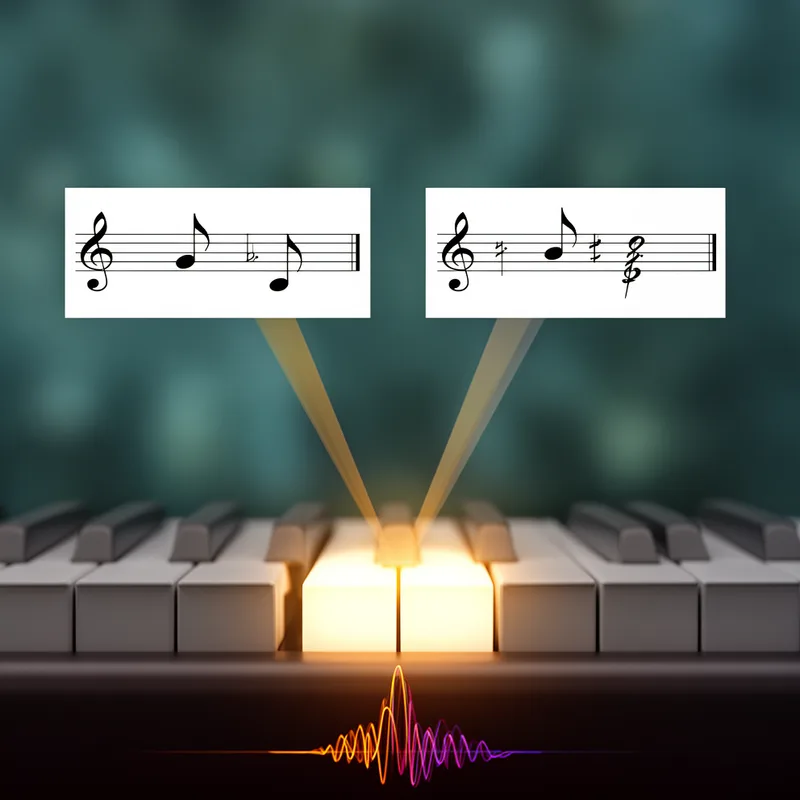
enharmonic
8.6
A note, interval or chord that sounds the same as another but is written differently
- noun
- /ˌɛn.hɑːrˈmɒn.ɪk/
- Specialized
:
nota enarmónica
- The composer used an enharmonic to smoothly change keys in the piece.
Examples
-
The note enharmonic to C♯ is D♭.
-
In music theory, F sharp and G flat are considered enharmonic notes.
-
Understanding enharmonic equivalents is important for reading complex sheet music.
-
Many musicians learn about enharmonic equivalents in music theory.
-
In music theory, F sharp and G flat are considered enharmonic notes.
-
Many musicians learn about enharmonic equivalents in music theory.
-
Understanding enharmonic equivalents is important for reading complex sheet music.
Surface Forms
enharmonic singular
enharmonics plural
Morphology
Etymology
Enharmonic as a noun is named from en- 'in' and harmonic from harmony 'agreement of sound', so an enharmonic is a note that is 'in harmony' with another note, which means it sounds the same even though it is written differently in music.

