
enantiomeric


 1
9.9
- adjective
- /ɪˌnæn.ti.oʊˈmɛr.ɪk/
- Specialized
Examples
-
He beckoned to Leon and Noel, the two enantiomeric bouncers.
Fiction book (1994) -
The first two are mutual enantiomers, but the last exists as two enantiomeric forms (fig. 3), TcO(L-pen)(D-pen) and TcO(D-pen)(L-pen). Sodium aurothiomalate
Academic text (1991) -
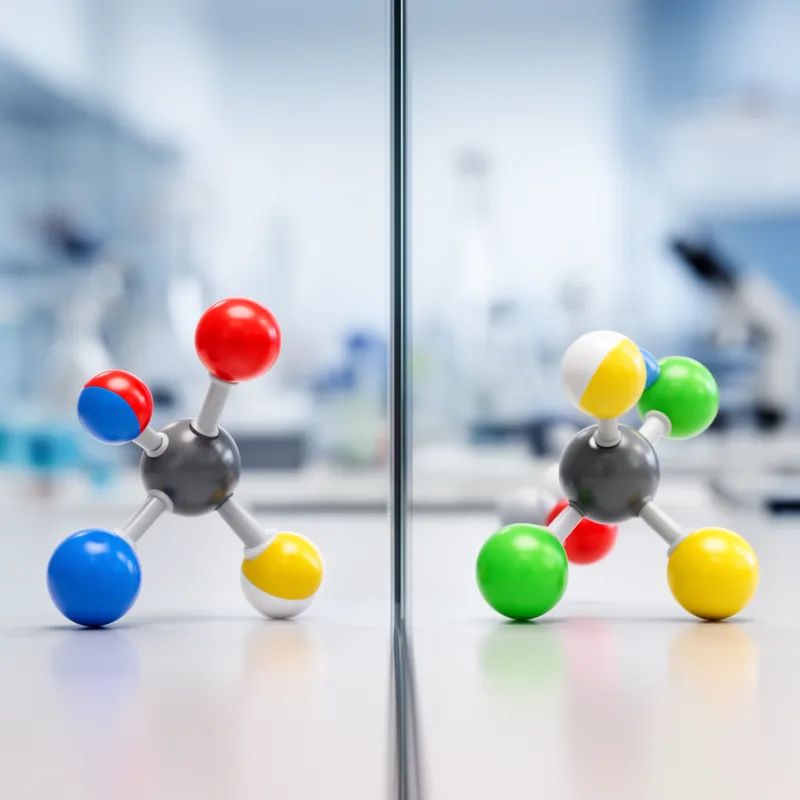
The two enantiomeric molecules are like a pair of hands; they cannot be superimposed.
-
In the study of chiral compounds, understanding how enantiomeric forms interact is crucial.
-
The chemist demonstrated the enantiomeric nature of the compounds by using a model that highlighted their mirror images.
Synonyms
 1
9.9
A shape that is a mirror image of another but cannot match it by turning, like left and right hands
Surface Forms
Morphology
enantiomeric = enantiomer (semi-transparent) = enantiomer + ic
Forming an adjective with the productive suffix '-ic' from the noun 'enantiomer' is a regular and clear morphological step.
Etymology
Enantiomeric comes from parts meaning 'opposite', called enanti-, and 'part', called -mer, a part you also see in polymer. So an enantiomeric molecule is a mirror image of another — you cannot put one on top of the other and have them match — and that is why mirror-image molecules can behave very differently, for example in drugs.