
electrostatic charge
 2
6.2
2
6.2

- noun
- /ɪˌlɛk.trəʊˈstæt.ɪk tʃɑrdʒ/
- Specialized
- But that electron feels the average electrostatic charge distribution of all the other electrons.
- residual electrostatic charge
- levels of electrostatic charge
Examples
-
And if there's any contaminants in the air, it increases the electrostatic charge which removes contaminants.
-
Then he used Hauksbee's electrical machine to generate electrostatic charge, that would accumulate and travel along this arm and out through this copper wire.
-
One theory looks to electrostatic charge to answer this.
-
"Particles from the solar wind give the dust an electrostatic charge.
Fiction book (2001) -
Those attractions were no doubt the effects of electrostatic charges produced by temperature changes, most probably in the mineral tourmaline.
Academic text (2005) -
It occurred to him that the star might have had a slight electrostatic charge, since its sheen suggested it was made of either metallic or plastic material.
Fiction book (1999) -
"The electrostatic charge captures most dust particles in the filter," said Bob Thompson, an electrical engineer and principal engineer on the RASA project at Pacific Northwest.
Academic text (2000) -
It places a strong electrostatic charge on airborne dust and microorganisms like Salmonella, which later collect on litter or on grounded room surfaces or collector plates.
Academic text (2006) -
Take measures to prevent the buildup of electrostatic charge on sensitive equipment.
-
Certain transporters leave behind a residual electrostatic charge that can attract dust.
Synonyms
 11
4.1
11
4.1
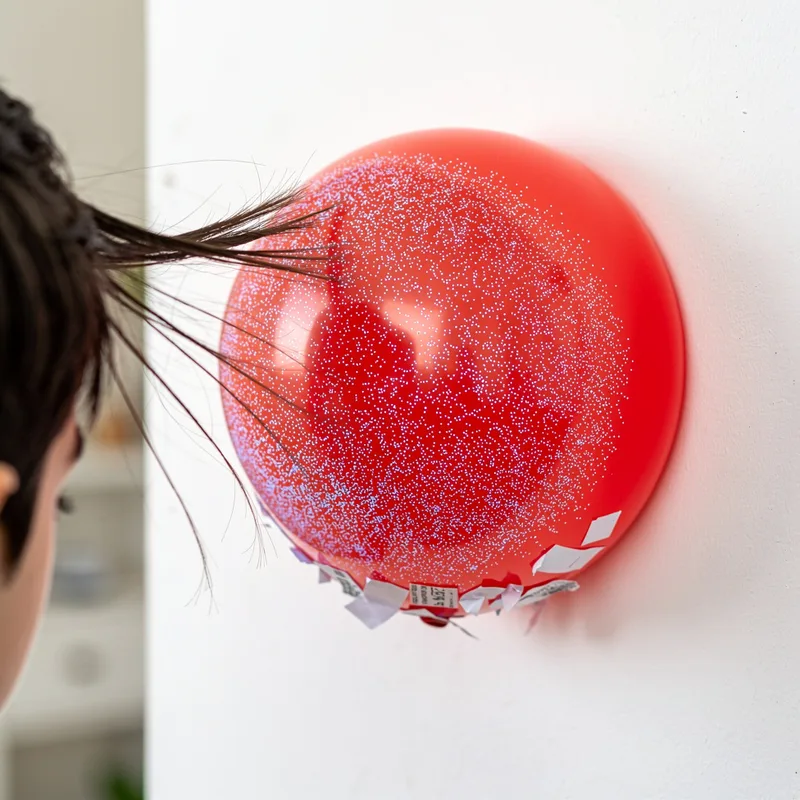
An electric charge that builds on a surface when things rub together, causing small shocks or making hair stand
 2
3.9
2
3.9
A quality in objects that makes them pull together or push apart, called positive and negative
Surface Forms
Morphology
The noun phrase is directly compositional: 'electrostatic' (relating to static electricity) modifies 'charge' (an excess or deficiency of electrons), so a learner who knows both parts can infer it denotes an electric charge that is stationary. This follows standard scientific compounding and is cross-linguistically transparent, so the overall meaning is predictable from the constituents.
Etymology
The term electrostatic charge comes from the simple image of rubbing a balloon on your hair: small bits of electricity stay on the object's surface, so the charge can make the balloon 'stick' to the wall or your hair 'stand up'. So, electrostatic here means electric energy that 'stays' on a surface and can make nearby things 'stick' or move, which explains the phrase's modern meaning.