
electric dipole moment
- noun
- Specialized
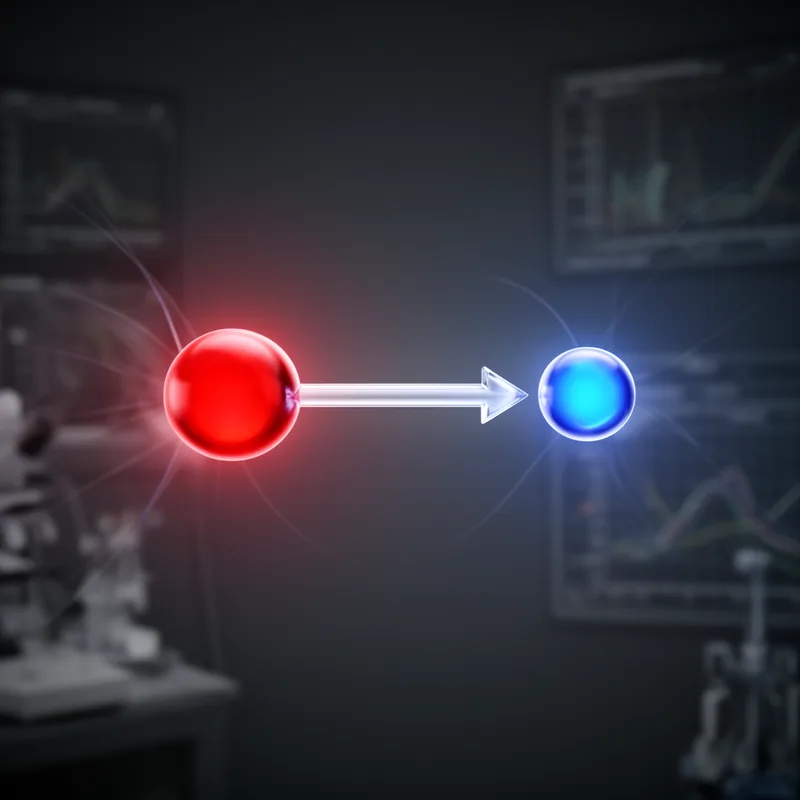
- The electric dipole moment of a molecule indicates the distribution of positive and negative charges within it.
- neutron electric dipole moment
Loading YouTube…
Watch on YouTubeAnd if you generalize this argument, we have ruled out that there is an electric dipole moment, an odd electric moment.
- And if you generalize this argument, we have ruled out that there is an electric dipole moment, an odd electric moment.
Examples
-
Protected by the several layers of magnetic shielding visible at right, it was used by researchers at the Institut Laue-Langevin to set an upper bound of well below 10^-25 e-cm on the neutron electric dipole moment.
Academic text (2012) -
OK, the first symmetry that would forbid electric dipole moment is reflection symmetry.
-
And if you generalize this argument, we have ruled out that there is an electric dipole moment, an odd electric moment.
-
To be explicit, the upper limit on the neutron's electric dipole moment, which provides the most sensitive test of P and CP violation by the strong interactions, requires that 0 of QCD be less than 10^-9.
Academic text (1996) -
Researchers calculated the electric dipole moment to better understand the molecule's behavior in an electric field.
-
Measuring the electric dipole moment is crucial for studying the properties of materials under electromagnetic influence.
Synonyms


 1
8.1
1
8.1
A measure of how far positive and negative charges are separated in a molecule
Surface Forms
Morphology
The phrase is compositionally built from 'electric' (relating to electric charge), 'dipole' (two opposite charges/poles separated) and 'moment' (a physical measure often involving a quantity times a distance), so a learner can partly infer that it denotes a measure of separated charges. However, the precise quantitative sense (that it equals charge magnitude times separation) and the technical use of 'dipole' and 'moment' require domain knowledge, so the meaning is not fully predictable to a B1 learner.
Etymology
The term electric dipole moment comes from a simple picture: two opposite charges, one positive and one negative, placed a short distance apart like a tiny plus and minus on a stick. The word dipole means 'two poles' and moment is like 'strength times distance', so the term measures how strongly separated charges will respond to an electric field.