
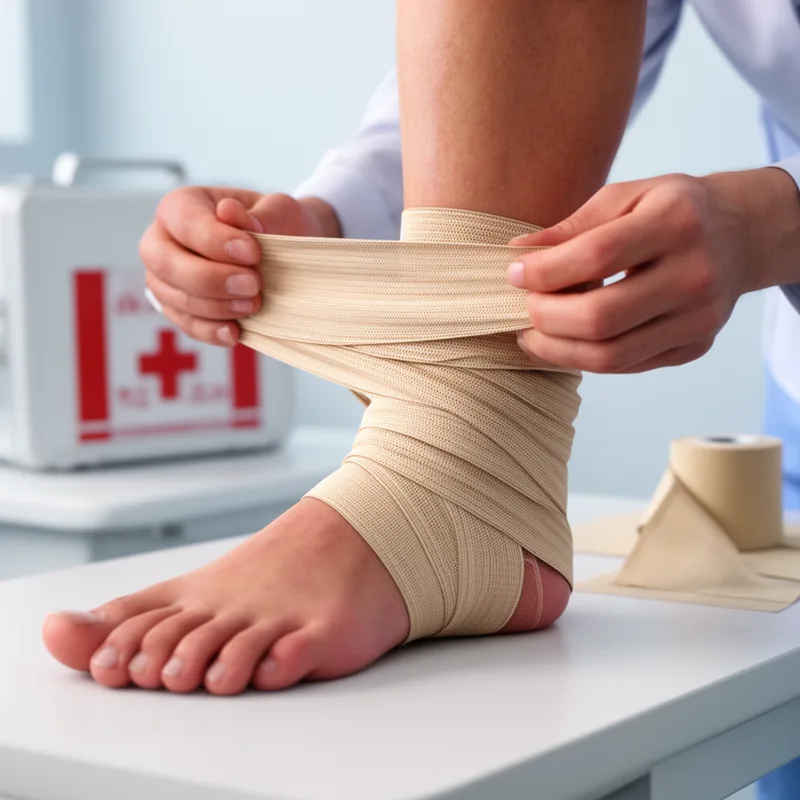
elastic bandage


 1
2.6
1
2.6
- noun
- /ɪˈlæstɪk ˈbændɪdʒ/
- To treat the sprained knee, the trainer used an elastic bandage to provide compression and stability.
Examples
-
After twisting her ankle, she applied an elastic bandage to help reduce the swelling.
-
My mother wrapped my ribs with an old Ace elastic bandage.
Fiction book (2000) -
She had wrapped it tightly with an elastic bandage.
Fiction book (1999) -
The doctor instructed him to keep his wrist wrapped in an elastic bandage for support after the injury.
Synonyms
 11
7.9
11
7.9
A long strip of cloth that wraps around a body part like an arm or leg
 1
3.5
1
3.5
A small sticky bandage that covers and protects a cut

A roll of cloth used to wrap wounds or support injured body parts

A bandage that presses on a wound to stop heavy bleeding
Antonyms

- Specialized
A cloth bandage soaked in hard plaster that becomes rigid to keep a body part still
How Supportive

Surface Forms
Morphology
The meaning is directly derivable from 'elastic' (stretchable, springs back) + 'bandage' (material for wrapping/protecting a wound): an elastic bandage is simply a bandage made of stretchable material used to wrap and support injuries. This compound follows a standard adjective+noun composition common across languages, so a B1 learner who knows both words will readily infer the MWE's meaning.
Etymology
Elastic bandage is a literal name: a bandage made from elastic cloth that you wrap around an injured joint. Because it stretches and presses, it 'supports' the area and helps 'reduce swelling', so the name matches what it does.