

egg-laying mammal


 1
7.6
1
7.6
- noun
- /ˈɛɡˌleɪɪŋ ˈmæməl/
- Specialized
 :
mamífero ovíparo
:
mamífero ovíparo
- Echidnas, which are also egg-laying mammals, primarily inhabit Australia and New Guinea.
Examples
-
Did you know that the platypus is an egg-laying mammal?
-
The egg-laying mammal is a unique creature.
-
Echidnas are one type of egg-laying mammal found in the wild.
-
Scientists study the reproductive systems of egg-laying mammals to understand mammalian evolution.
-
The platypus is an unusual egg-laying mammal native to Australia.
-
The platypus is a fascinating example of an egg-laying mammal that thrives in aquatic environments.
-
Scientists study the rare features of an egg-laying mammal to better understand mammalian evolution.
Synonyms
 1
9.9
1
9.9
A mammal that lays eggs instead of giving birth, like a platypus or echidna
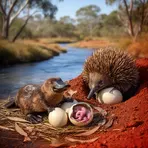
A mammal that lays eggs, like the platypus or echidna, from Australia, Tasmania, and New Guinea
Surface Forms
Morphology
egg-laying + mammal
The noun phrase is fully compositional: 'egg-laying' (one that lays eggs) modifies 'mammal', so the meaning 'a mammal that lays eggs' is directly derivable from the constituents. This modifier+noun pattern is a standard, cross-linguistic construction that a B1 learner who knows the parts would readily understand.
Etymology
Egg-laying mammal is a simple name that gives a clear picture: a mammal laying an egg, which is odd because most mammals have live babies. So, the phrase means 'a mammal that lays eggs', like the platypus or echidna.