
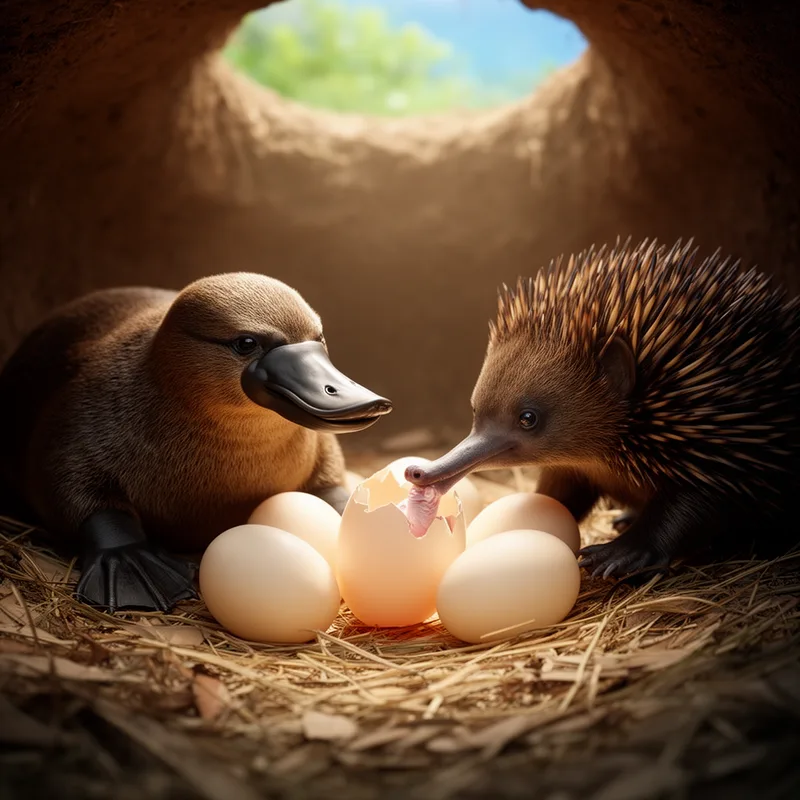
monotreme


 1
9.9
1
9.9
- noun
- /ˈmɒnəˌtriːm/
- Specialized
- This new gene was SRY, and according to Graves, it must have appeared no later than 130 million years ago, when the last common ancestor of all living mammals apart from monotremes is believed to have lived.
- monotremes like the platypus
- egg-laying monotremes
- monotremes and mammals
Examples
-
Thus, mammalian genomic imprinting is thought to have evolved after the therian-monotreme divergence.
Blog text (26) -
Monotremes do have Y chromosomes, and the males develop a penis and testicles and produce sperm.
Academic text (2002) -
Down under, in Oz, there is a small, awfully cute monotreme known as the echidna.
Fiction book (2001) -
Scientists are now searching for the trigger gene that actually builds male monotremes.
Academic text (2002) -
Then, about 170 million years ago, when the monotremes branched off, they kept their Y chromosome.
Academic text (2002) -
In vertebrates, imprinting is restricted to the therian (marsupial and eutherian) mammals, but as yet no imprinted genes have been identified in monotremes 1, 2.
Blog text (26) -
The platypus is one of the most well-known monotremes because it lays eggs instead of giving birth to live young.
-
In Australia, a fascinating monotreme called the echidna can be found foraging for ants and termites.
-
Biologists study monotremes to understand how these unique egg-laying mammals evolved from their ancestors.
Synonyms
 1
7.6
1
7.6
A mammal that lays eggs, like the platypus or echidna
A mammal that lays eggs, like the platypus or echidna, from Australia, Tasmania, and New Guinea
Surface Forms
Morphology
monotreme = mono + treme
The prefix mono- is recognizable, but the second element is a bound classical form rather than a standalone English base, so the meaning is not readily recoverable for most learners.
Etymology
Monotreme comes from Greek parts mono- 'one' and trema 'hole', the same mono- you see in monotone. It names mammals that have a single body opening used for laying eggs and for other needs, which explains why animals like the platypus lay eggs instead of giving live young.