
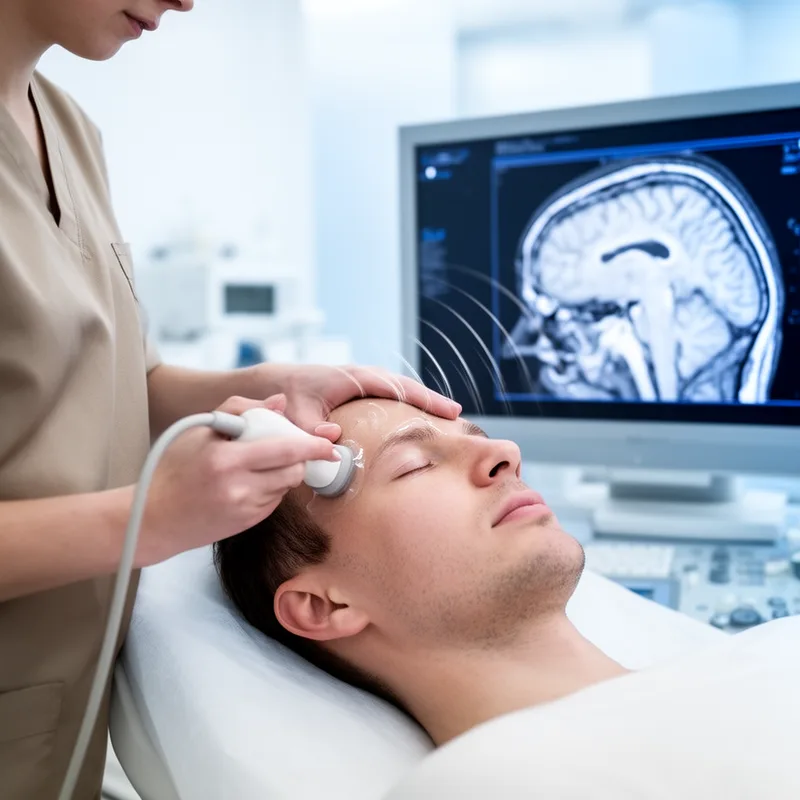
echoencephalography
- noun
- /ˌɛkoʊˌɛnˌsɛfəˈlɑɡrəfi/
- Specialized
- The neurologist ordered an echoencephalography to help diagnose the patient's symptoms.
Examples
-
Recent advances in echoencephalography have improved the detection of brain abnormalities in infants.
-
Before MRI became widespread, echoencephalography was commonly used to assess brain injuries.
-
The doctor recommended an echoencephalography for further evaluation.
-
Have you had an echoencephalography done recently?
-
The neurologist recommended an echoencephalography to examine the patient's brain structure.
-
Recent studies show that echoencephalography is effective in detecting early signs of brain disorders.
-
Before starting treatment, the doctor performed an echoencephalography to understand the anatomy of the brain.
Synonyms
 109
4.1
109
4.1

A scan using high sound waves to make images of the inside of the body
 1
5.6
1
5.6
To make images of the inside of the body using sound waves


 1
5.1
1
5.1
A medical test using sound waves to make pictures of organs inside the body
A medical scan that uses sound waves to make pictures of the inside of the body
How Informative
- Specialized

- Specialized
Surface Forms
Morphology
echoencephalography = echo + encephal + graphy
Opaque specialized medical term built from the combining forms echo-, encephal-, and -graphy, so an average B1 learner is unlikely to infer the meaning from the parts alone.
Etymology
Echoencephalography breaks into echo- 'sound that comes back', encephalo- 'brain', and -graphy 'recording', a part you can see in photography, which is 'taking a picture'. So it means 'recording the brain with echoes', which fits a test that uses sound waves to look at the brain.