

ecclesiastical calendar
- noun
- /ɪˌklizɪˈæstɪkəl ˈkælɪndər/
- Formal
- Each included menus for noble dinners that consisted overwhelmingly of meat courses; Rabisha described 'A Bill of Fare for an Extraordinary Feast, on a Flesh-Day in the Spring'; a flesh day being a day on which meat could be eaten according to the ecclesiastical calendar, that is, most days.
Examples
-
The ecclesiastical calendar outlines the important festivals and fasts for the Christian faith.
-
Many churches refer to the ecclesiastical calendar to schedule their religious events throughout the year.
-
In the ecclesiastical calendar, Easter and Christmas are among the most significant celebrations.
Synonyms


 1
3.6
1
3.6
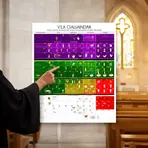
A calendar showing Christian holy days, festivals, and fasting times throughout the year
 1
5.1
1
5.1
A yearly cycle of seasons and special days that Christians observe, like Christmas and Easter
Surface Forms
Morphology
The meaning is directly and transparently derivable from 'ecclesiastical' (related to the Christian Church) combined with 'calendar' (a system of dates): it straightforwardly denotes a calendar used for church feasts and fasts. This adjective–noun composition is compositional and cross-linguistically common, so a B1 learner who knows both constituents would readily infer the intended meaning.
Etymology
Ecclesiastical calendar The phrase ecclesiastical calendar comes from the church practice of keeping a special calendar of holy days and fasts. The word ecclesiastical means 'of the church', so the phrase is the church's calendar that shows when to 'celebrate' or 'fast'.