

to drive off
 87
4.0
87
4.0

- phrasal verb
- /draɪv ɔf/
- She tried to drive off the stray dog by waving her arms fiercely.
- drive off the land
Loading YouTube…
Watch on YouTubeThe Union soldiers drive the Confederates off.
- The Union soldiers drive the Confederates off.
Examples
-
Don't you know every time you drive off, we're terrified?
-
Then he muttered, "Jesus Christ!" Rolling up his window, he drove off without looking back.
Fiction book (1991) -
Come on man, are you seriously gonna let her drive off in your own truck with another man?
-
At this point they drove off, leaving poor Jim to go back home on his own.
-
That guy just drove off, I bet we'll never hear from him again.
-
And a moment later, he drove off, and that chapter in his life was over.
Fiction book (1991) -
They put your father into a car and drove off.
-
So we drove off to Pasadena the only doctor that was open at that time of night.
-
They just threw her in the back seat of the car and then drove off.
-
Then the two of them drove off, drunk as coots, to spend their wedding night at Nell Nolan's.
Fiction book (1990)
Synonyms
 71
3.4
71
3.4
To force a person, animal, or feeling to go away
 70
3.8
70
3.8
Force someone or something to leave a place
 29
4.6
29
4.6
To make a feeling or idea go away
 26
2.6
26
2.6
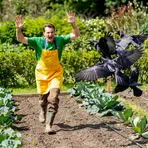
To make people or things leave by scaring them
 25
4.7
25
4.7
Make someone or something go away
 19
4.1
19
4.1
Force someone or something to move away from danger
 6
3.3
6
3.3
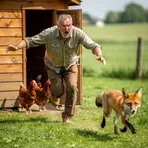
Make someone or something leave a place by running after and frightening them
Antonyms


How Forceful
107
6.3
 194
5.0
194
5.0
- Informal
4
7.9
87
4.0
37
2.0
Surface Forms
Morphology
The meaning 'to force someone or something to leave' is directly and compositionally derived from 'drive' (to force or propel) + 'off' (away from a place). This motion/expulsion pattern is common cross-linguistically and follows a standard verb + particle construction, so a B1 learner who knows both constituents can reliably infer the MWE meaning.
Etymology
Drive off comes from the image of a farmer or shepherd using a stick or voice to drive animals off a field so they move away. That's why it means 'to force someone or something to leave'.