

domestic animal
 3
1.6
3
1.6

- noun
- /dəˈmɛstɪk ˈænɪməl/
- The Nipah outbreak highlights what can happen when people and domestic animals modify previously undisturbed wild habitats.
- wild and domestic animals
- humans and domestic animals
- grazing by domestic animals
Loading YouTube…
Watch on YouTubeLike we project emotions onto domestic animals all the time.
- Like we project emotions onto domestic animals all the time.
- So even though we consume a lot, our domestic animals consume about twice more.
Examples
-
So even though we consume a lot, our domestic animals consume about twice more.
-
To provide shipwreck victims with a food source, domestic animals and vegetation were introduced to the island.
Academic text (1995) -
I need to not let domestic animals free.
-
On some of the islands, the nuts are fed to domestic animals.
Fiction book (2002) -
Some studies show that the presence of domestic animals can help students suffering from anxiety or depression.
Academic text (2016) -
Among her findings is that as time passed, over-grazing by domestic animals caused a decline in high-quality forage.
Academic text (2004) -
34. In the subsistence stage, living in close proximity to domestic animals constantly exposes people to zoonotic diseases.
Academic text (2006) -
Many families choose to adopt a domestic animal like a cat or dog for companionship.
-
Farmers rely on domestic animals such as cows and chickens for their livelihood.
-
Training a domestic animal can strengthen the bond between the pet and its owner.
Synonyms
 2
1.1
2
1.1
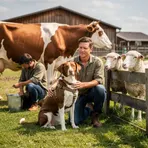
An animal people keep and breed to live with them or help them
Antonyms

How Domesticated

Surface Forms
Morphology
The phrase 'domestic animal' is compositionally transparent: 'domestic' (tamed/used by humans) modifies 'animal', so the combined meaning — an animal adapted to live with humans or used by people — is directly derivable from the parts. This ADJ+NOUN pattern is common across languages and follows ordinary semantic combination, so a B1 learner who knows both words will understand it.
Etymology
Domestic animal comes from the idea of an animal kept in the domestic 'home' by people and cared for instead of living wild. That's why it means 'an animal kept by people as a pet or on a farm'.