

division Euglenophyta
- noun
- /dɪˈvɪʒən juːɡlɪˈnɒfɪtə/
- Specialized
- Members of division Euglenophyta exhibit both plant-like and animal-like characteristics.
Examples
-
Freshwater samples revealed a high abundance of organisms from division Euglenophyta.
-
Did you know that the division Euglenophyta is primarily aquatic?
-
Scientists studied the structure of division Euglenophyta under the microscope.
-
The division Euglenophyta includes many fascinating species.
-
Freshwater samples revealed a high abundance of organisms from division Euglenophyta.
-
Members of division Euglenophyta exhibit both plant-like and animal-like characteristics.
-
Scientists studied the structure of division Euglenophyta under the microscope.
Synonyms
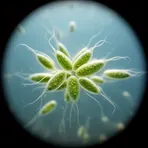
A group of mostly single-celled water organisms like algae that move using a thin tail-like part
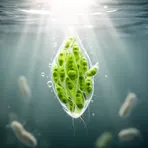
A group of one-celled freshwater living things with a tail-like part that often make food like plants
Surface Forms
Morphology
This is a fully compositional taxonomic label: 'division' names a rank and 'Euglenophyta' names the group, so a learner who knows both constituents can infer it refers to the taxonomic group of Euglenophyta. Although technical, such scientific naming patterns are cross-linguistically regular and directly interpretable from the parts.
Etymology
Division Euglenophyta is named after the tiny cells called Euglena and the ending -phyta, which means 'plants'. One popular idea is that Euglena refers to their bright red 'eye' spot and the little tail they use to swim, so the name creates a clear image and explains why we use it for this group of freshwater, single-celled algae.

