
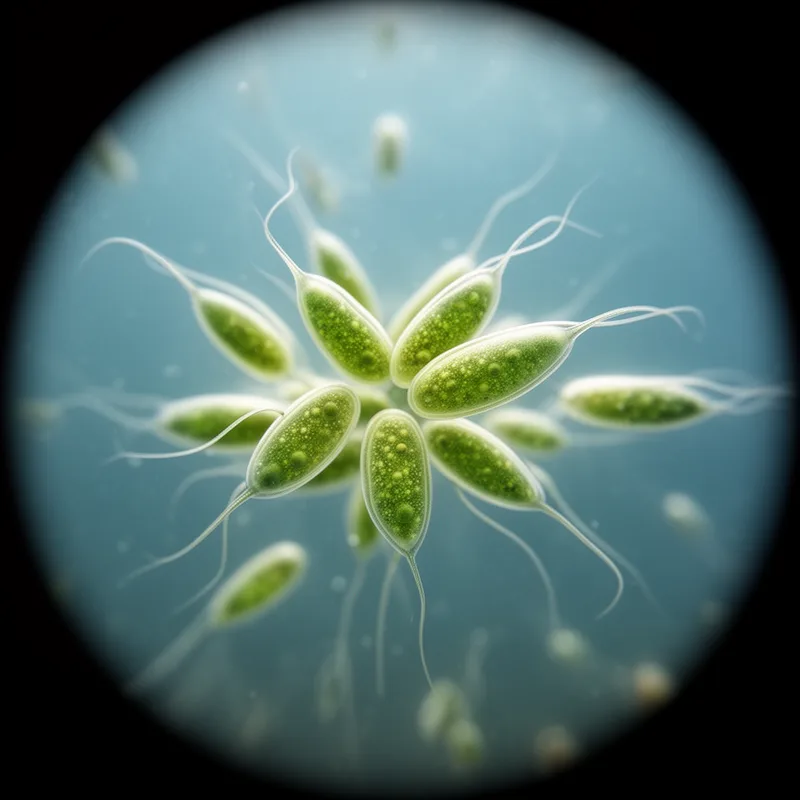
Euglenophyta
- noun
- /juːˌɡlɛnəˈfaɪtə/
- Specialized
- Many species of Euglenophyta have chloroplasts for photosynthesis.
Examples
-
The microscope revealed several Euglenophyta cells swimming rapidly in the water sample.
-
Some species within Euglenophyta can survive in polluted water environments.
-
Researchers study Euglenophyta to better understand photosynthetic mechanisms in single-celled organisms.
-
The Euglenophyta are fascinating organisms found in freshwater environments.
-
Researchers study Euglenophyta to better understand photosynthetic mechanisms in aquatic algae.
-
The microscope revealed several Euglenophyta cells moving swiftly in the water sample.
-
Some species within Euglenophyta are known for their ability to thrive in various water conditions.
Synonyms

A group of small, free-swimming algae that move with a tail and live in fresh water
Compounds
- Specialized
A group of small, free-swimming algae that move with a tail and live in fresh water
Surface Forms
Morphology
Euglenophyta = Euglena (opaque) = Euglena + phyta
Formed from a genus name plus the technical taxonomic suffix '-phyta' (meaning 'plants'); this is specialized scientific morphology not transparent to general learners.
Etymology
The word Euglenophyta comes from the name Euglena, built from eu- 'good' and glene 'eye' because many of these tiny algae have a light-sensing eye spot, and the ending -phyta means 'plants', like in phytoplankton. So, Euglenophyta can be remembered as 'eye plants', which fits these single-celled, plant-like algae that move and sense light.

