

direct current
 3
3.5
3
3.5

- noun
- /dəˈrɛkt ˈkʌrənt/
- Specialized
- Most electronic devices, including smartphones, run on direct current to ensure stable performance.
- direct current (DC)
- direct current motor
- direct current stimulation
Loading YouTube…
Watch on YouTubeLet's revisit this direct current brain stimulation for the amplification, let's say extension of of deep sleep.
- Let's revisit this direct current brain stimulation for the amplification, let's say extension of of deep sleep.
Examples
-
Whatever type of module is used, a direct current and power in the range of 50 to 60 watts will be produced.
Academic text (1994) -
The voltage in a direct current system remains constant over time, making it reliable for many applications.
-
Its efficiency without question is equal to the best direct current motor.
-
Direct current may be fine for cities when the buildings are close together, but most of your country is empty spaces.
-
Direct current is like a river flowing peacefully to the sea.
-
Direct current flows like water through a pipe.
-
At first they all worked with Thomas Edison's direct current system, DC for short.
-
The electrical current from a photovoltaic system is direct current (DC).
Academic text (2011) -
Edison invented direct current, but it was Nikola Tesla who invented alternating current.
-
Industrialist Westinghouse was promoting Tesla's alternating current, AC, while Thomas Edison tried to sell direct current, DC.
Synonyms

An electric flow that moves in one direction and does not reverse
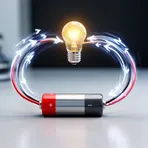
An electric current that flows in one direction
Antonyms

How Often


Surface Forms
Morphology
The meaning is compositionally built from 'direct' (one-directional) + 'current' (a flow of charge), so 'an electric current that flows in one direction' is directly derivable from the constituents. This adjective+noun pattern is regular and cross-linguistically common, so a B1 learner who knows both words should be able to infer the MWE's meaning.
Etymology
Direct current gets its name from the picture of current as a steady flow and direct meaning straight. Because it 'flows in one direction', like water moving down a single pipe, the phrase describes electric flow that does not go back and forth.