
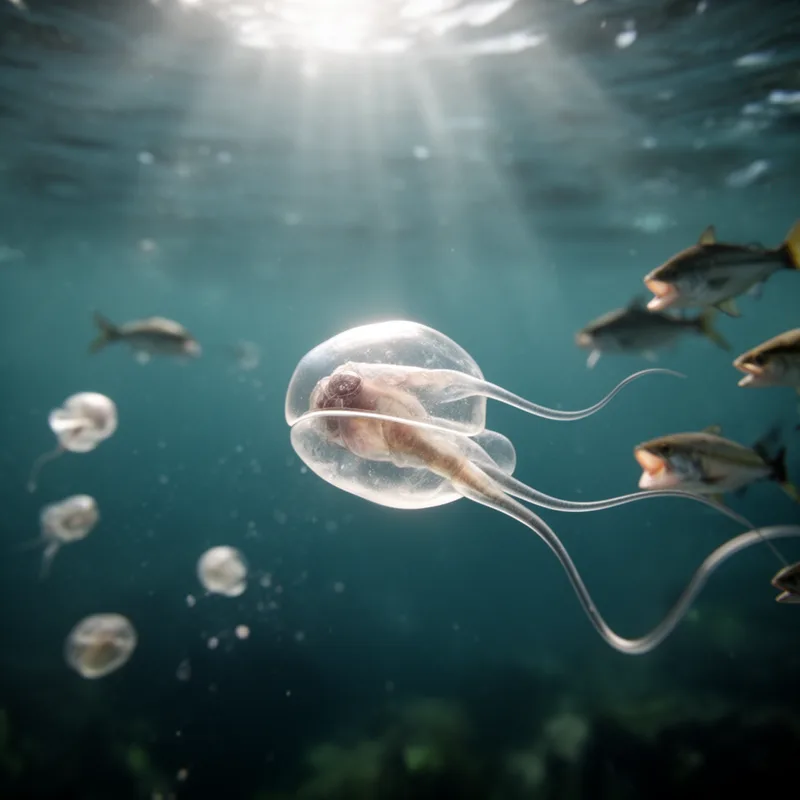
dinoflagellate
 1
9.9
1
9.9

- noun
- /ˌdaɪnəˈflædʒəˌleɪt/
- Specialized
- Under favorable conditions, dinoflagellate populations can soar to 60 million organisms per liter of water.
- toxic dinoflagellates
- marine dinoflagellate
- fish-killing dinoflagellate
Examples
-
A second example concerns certain species of marine planktonic dinoflagellates that, in massive concentrations, sometimes produce "red tides" in coastal waters.
Academic text (1996) -
Bloom-producing dinoflagellates have been found far back in the fossil record.
Academic text (2003) -
The scientific name for this microorganism is dinoflagellate, which needs to photosynthesize in order to survive.
Blog text (31) -
The dinoflagellate lives in a dormant state, lying on the sea floor within a protective cyst.
Academic text (1995) -
OK, so that light was made by a bioluminescent dinoflagellate, a single celled alga.
-
Isolation of dinoflagellates and cultivation from environmental samples to confirm identity may take months.
Blog text (18) -
Red tides are an unusual condition associated with a bloom of dinoflagellates in marine waters, which gives the water a red, yellow, or brown tint.
Academic text (1996) -
Some high nutrient concentrations can also trigger blooms of a type of plankton (dinoflagellate) that produces very potent toxins deadly to marine organisms and humans.
Academic text (1999) -
Dinoflagellates are a crucial part of the ocean ecosystem, serving as a primary food source for various marine animals.
-
During summer, the waters can shimmer at night due to the presence of glowing dinoflagellates.
Synonyms

A group of single-celled algae with two tail-like parts that sometimes glow and cause red tides
A single-celled creature in water, some of which cause red tides
A group of single-celled water organisms once thought to be tiny animals but now often placed with algae
Surface Forms
Morphology
dinoflagellate = flagellate (semi-transparent) = dino + flagellate
The prefix 'dino-' is a non-standalone combining form used in scientific terms and may not be meaningful to general learners, while 'flagellate' is technical but clearly refers to flagella for those with biology knowledge.
Etymology
Dinoflagellate comes from two parts: dino- meaning 'whirling' and flagellate from a word for 'whip' and flagellum meaning 'little tail'. These tiny sea cells often spin and move with whip-like tails, so the name helps you remember their spinning motion and tail-like flagella.