

dialysis
 60
5.0
60
5.0

- noun
- /daɪˈælɪsɪs/
- Specialized
- During dialysis, toxins are removed from the blood through a semipermeable membrane.
- dialysis patients
- peritoneal dialysis
- haemodialysis
Loading YouTube…
Watch on YouTubeThe longer you have that you're on dialysis, it does indeed affect your mortality.
- The longer you have that you're on dialysis, it does indeed affect your mortality.
- She usually stops and says hello, but she needs she's late for dialysis.
- You know, people can live decades without kidneys as long as they get dialysis, which does the work for them.
- The wait time for a donor kidney is often longer than a patient can survive on dialysis.
- You take your patients at that early time point and you randomize them to either start dialysis or wait, and that's when the clock starts ticking.
- I actually woke up this morning and I texted a nurse saying I think I need to be put on dialysis.
- And then one day it was closed in a DaVita dialysis place.
- They go into the schools, they go into the federal and state dialysis clinics, ERS.
- We're dealing with very, very costly diseases, cancers, cardiac bypass, renal dialysis.
Examples
-
Many times, I wanted to quit dialysis, and I almost did.
Fiction book (1999) -
His EKG showed signs of a heart attack during dialysis, but he's stable now.
-
So one in five patients who are on dialysis will die each year.
-
You know, I will be leading a life on dialysis, right?
-
Is this the dialysis department?
-
First, the results are based on a single dialysis program with a relatively small number of patients.
Academic text (2008) -
In the days before dialysis, to keep drinking was the only treatment available.
Fiction book (1996) -
You know, people can live decades without kidneys as long as they get dialysis, which does the work for them.
-
I'm still here even after 10 years of dialysis, although I have my on-and-off days.
Fiction book (1999) -
Oh, Elsa's on dialysis.
Compounds
- Specialized
4
3.5
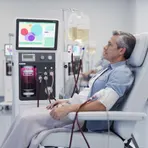
A machine that removes waste and extra fluid from a person's blood when their kidneys fail
How Thorough
15
4.6

- Specialized
1
5.9
- Specialized
60
5.0
- Specialized
15
3.8
8
3.2
Surface Forms
Morphology
Etymology
Dialysis comes from the Greek parts dia- 'through' and -lysis 'loosening' or 'breaking down'. So, dialysis is like 'passing through to break apart', which helps you remember the process of letting small parts pass through a thin barrier to separate them from a liquid.