

desert lynx
- noun
- /ˈdɛzərt lɪŋks/
- The desert lynx prowls the arid regions of northern Africa, hunting small mammals at dusk.
Examples
-
In the early morning light, the desert lynx displays its impressive tufted ears while resting atop a rock.
-
Unlike many other wild cats, the desert lynx thrives in harsh, dry environments.
-
Wildlife photographers traveled to capture images of the elusive desert lynx in its natural habitat.
-
The desert lynx is known for its striking appearance.
-
Have you ever seen a desert lynx in the wild?
-
The desert lynx can be seen stalking its prey in the sandy dunes of southern Asia.
-
Due to its unique adaptations, the desert lynx can survive long periods without water.
Synonyms


 1
9.9
1
9.9
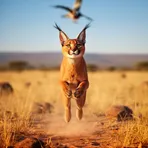
A medium-sized wild cat with long ear tufts that lives in dry parts of Africa and Asia
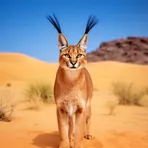
A wild cat with long black hairs on its ears that lives in deserts in northern Africa and southern Asia
Surface Forms
Morphology
The meaning is directly compositional: 'desert' specifies the habitat of the animal 'lynx', so a learner who knows both words can infer it denotes a lynx living in deserts. Although the term may refer specifically to the caracal, that taxonomic detail does not prevent the overall meaning being transparently derived from its constituents and follows a common noun+noun compounding pattern cross-linguistically.
Etymology
Desert lynx may come from a simple picture: people saw a slim, long-eared cat living in dry land and thought it looked like a lynx in a desert. That's why the name is used for the 'caracal', a 'wild cat' with long ear tufts.