
deflagration


 1
9.9
- noun
- /ˌdɛfləˈɡreɪʃən/
- Specialized
- A series of tests performed as part of a safety review for the Pantex facility at Sandia National Laboratories in Amarillo, Tex., showed that the use of such lubricants does not reduce the oil mist deflagration hazard.
- oil deflagration
- dust deflagration
- metal dust deflagration
Examples
-
Hazards involving chemical energy include oil and metal dust deflagration.
Academic text (1993) -
Experiments by the U.S. Bureau of Mines on metal dust deflagration were conducted with the same apparatus.
Academic text (1993) -
A very heavy silence, loaded with the potential of deflagration.
Fiction book (1997) -
Fortunately, the operator had his back turned when the deflagration occurred and was protected from flash burns by his clothing.
Academic text (1993) -
It has been suggested that the oil deflagration problem could be solved by replacing the normal petroleum lubricant used for the drive turbine with a phosphate-ester fire-safe lubricant.
Academic text (1993) -
The laboratory was evacuated after a sudden deflagration was reported during the experiment.
-
During the test, a deflagration was observed, indicating that the chemical reaction was more intense than expected.
-
The safety protocol includes measures to prevent deflagration caused by flammable materials in the facility.
Antonyms
How Fast

Surface Forms
Morphology
deflagration = flagration (opaque) = de + flagr + ation
The prefix 'de-' suggests removal or reversal, but in this context, it indicates a process of combustion, which is not immediately obvious.
Etymology
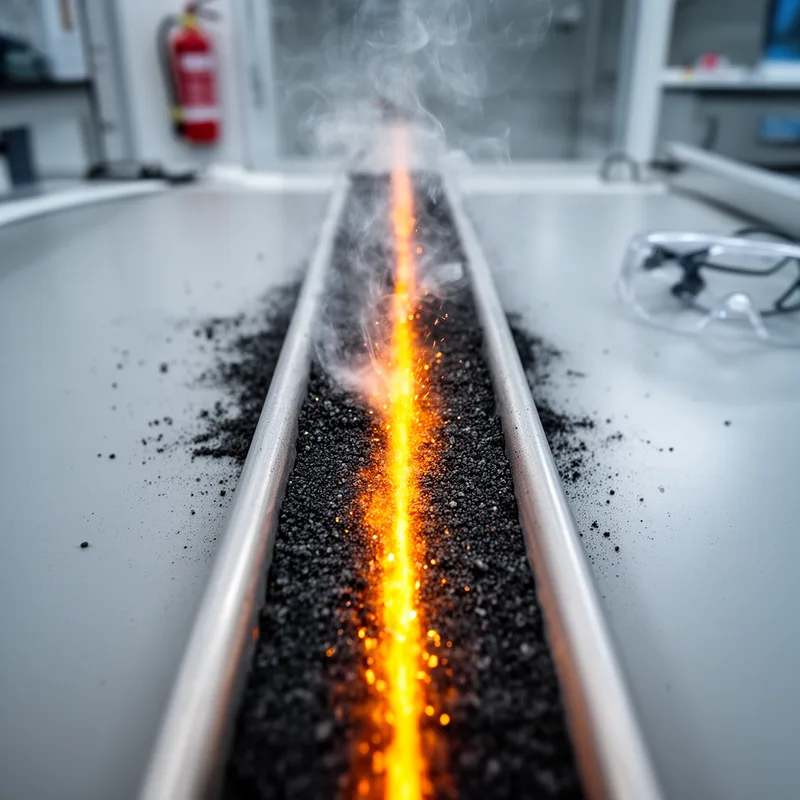
Deflagration comes from Latin parts de- and flagrare, which mean 'to burn', and you can see the same idea in the English word flame. So a deflagration is a fast kind of burning that spreads through a gas or along a surface by heat.