
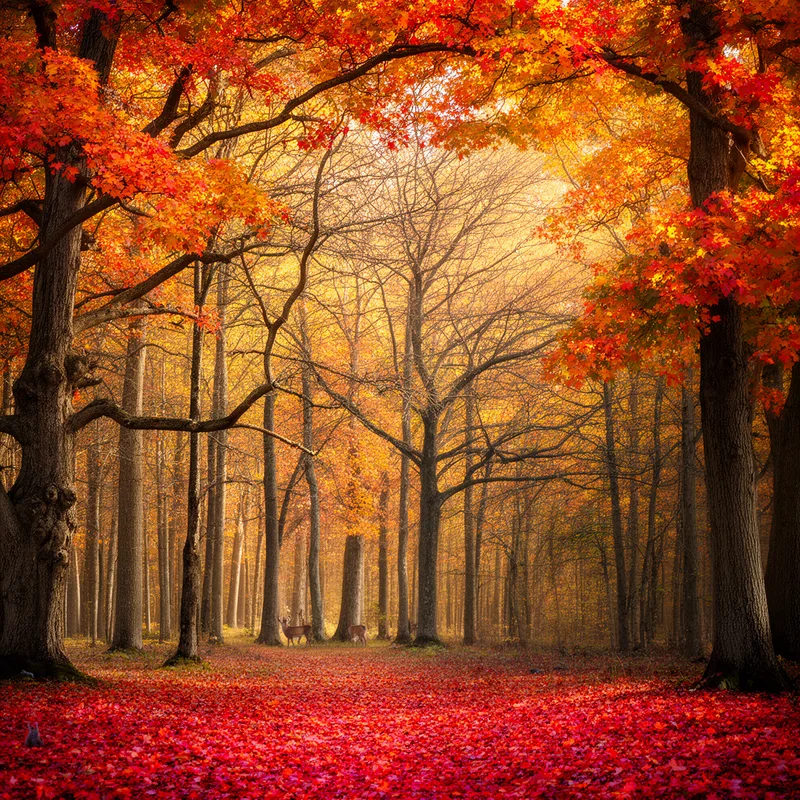
deciduous forest


 1
3.9
1
3.9
- noun
- /dɪˈsɪdʒuəs ˈfɔrɪst/
- The otter enjoys playing in the streams that run through the deciduous forest, especially during the warm months.
- eastern deciduous forest
- tropical deciduous forest
- temperate deciduous forest
Examples
-
The tulip poplar (Liriodendron tulipifera) thrives in the rich soil of a deciduous forest where it can grow tall and majestic.
-
Red maple occurs throughout the eastern deciduous forest and can grow on almost all site classes, from wet to xeric (Abrams 1998).
Academic text (2007) -
The Northern and Southern Mountains have steep terrain and mainly deciduous forest cover.
Academic text (2016) -
The terrain was rolling and covered with all of the northern deciduous forest trees that grew side by side with southern pines.
Academic text (2015) -
In contrast, the Richmond hole exhibits the mild rolling terrain and deciduous forest of central Virginia.
Academic text (2013) -
On his right was a milder, mostly deciduous forest, interspersed with meadows.
Fiction book (1999) -
Vegetation in northern Minnesota is changing from boreal forest to deciduous forest to, perhaps someday, open prairie.
Academic text (2009) -
The location of the Cherokee Nation is a biological crossroads of the plant communities of the eastern deciduous forest and the Great Plains to the west.
Academic text (2011) -
Also, the predominantly deciduous forest cover in the mountains has a longer rotation length than pine plantations in the Coastal Plain and Southern Piedmont.
Academic text (2016) -
The tulip poplar (Liriodendron tulipifera) is a majestic tree found naturally occurring in the deciduous forests east of the Mississippi.
Academic text (2011)
How Wet

Surface Forms
Morphology
The meaning is directly derivable from combining 'deciduous' (trees that lose leaves seasonally) with 'forest' (a tract dominated by trees), yielding 'a forest of leaf‑shedding trees.' This is a straightforward adjective + noun composition that follows regular morphological and cross‑linguistic patterns, so a B1 learner who knows both constituents will understand it.
Etymology
Deciduous forest: The name deciduous forest comes from the way trees in these woods drop their leaves every year. The word deciduous means 'to fall off', so the phrase describes a forest of trees that lose their leaves each autumn.