
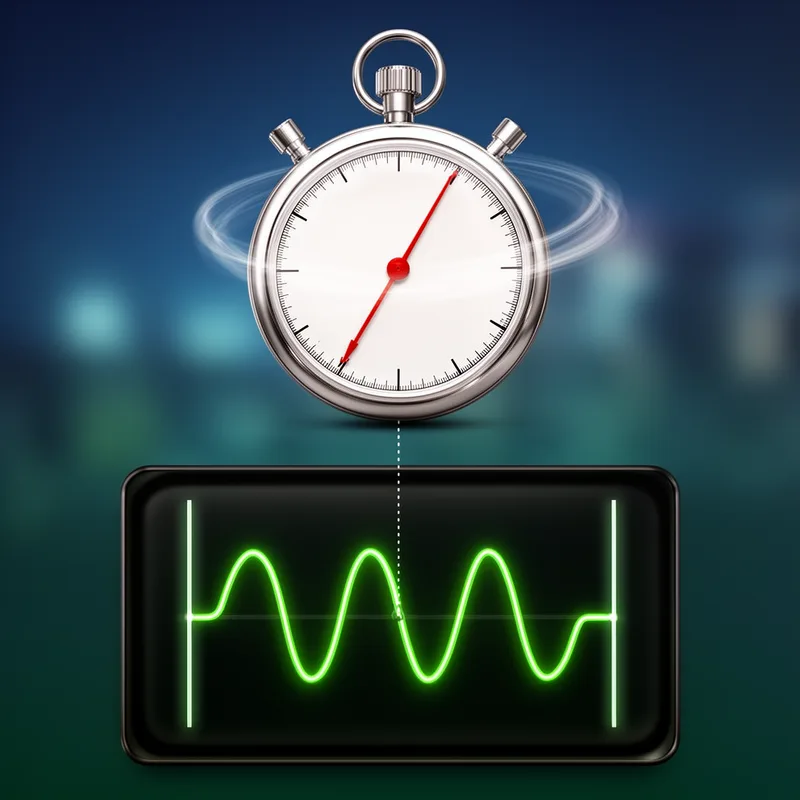
cycle per second
 2
4.1
2
4.1

- noun
- /ˈsaɪkəl pər ˈsɛkənd/
- Archaic
- The conveyor operates at 30 cycles per second, with a stroke of 0.187 inches.
Loading YouTube…
Watch on YouTubeIn fact, they were less than one Hertz, less than one cycle per second in terms of a pulse.
- In fact, they were less than one Hertz, less than one cycle per second in terms of a pulse.
- And each of them used a different notation, you know, frequency in cycles per second versus radians per second.
- Yeah, I specifically cycles per second.
Examples
-
The alpha waves are coming in at 12,78 cycles per second.
-
In fact, they were less than one Hertz, less than one cycle per second in terms of a pulse.
-
Place him in the beta state at six cycles per second.
-
It's kind of the number of cycles per second, or perhaps even something simpler.
-
Place her in an alpha state, 10 and a half cycles per second.
-
And zero to two cycles per second is called delta waves.
-
It's sticking up here around 1,950 cycles per second.
-
The original frequency of the CBR was some 3 trillion cycles per second.
-
A sampling rate of 20,000 Hz (or cycles per second) is used for the data acquisition system.
Academic text (2017) -
The audio signal oscillates at a frequency of 440 cycles per second, which corresponds to the musical note A above middle C.
Synonyms
 19
8.0
19
8.0
A measure of frequency equal to one hertz
 7
3.7
7
3.7
A measure of how many times something repeats each second
 5
4.8
5
4.8
A unit for measuring how many times a sound or light wave repeats each second
A unit that measures how many times something repeats each second
How Often

Surface Forms
Morphology
The meaning 'one oscillation each second' is directly and compositionally derivable from 'cycle' (a repeating event) + 'per' (indicating rate) + 'second' (time unit); a B1 learner who knows those words can infer it denotes frequency even if they do not know the technical term 'hertz'. This follows a common cross-linguistic rate construction (X per Y), so the expression is transparently understandable from its parts.
Etymology
Cycle per second shows a simple picture: one full repeat or turn, a cycle, happening in one second. So it was used to say 'how often something repeats', and today it still means that same measure equal to 'one hertz'.