
cryopreservation
 1
8.4
1
8.4

- noun
- /ˌkraɪoʊprɛzərˈveɪʃən/
- Specialized
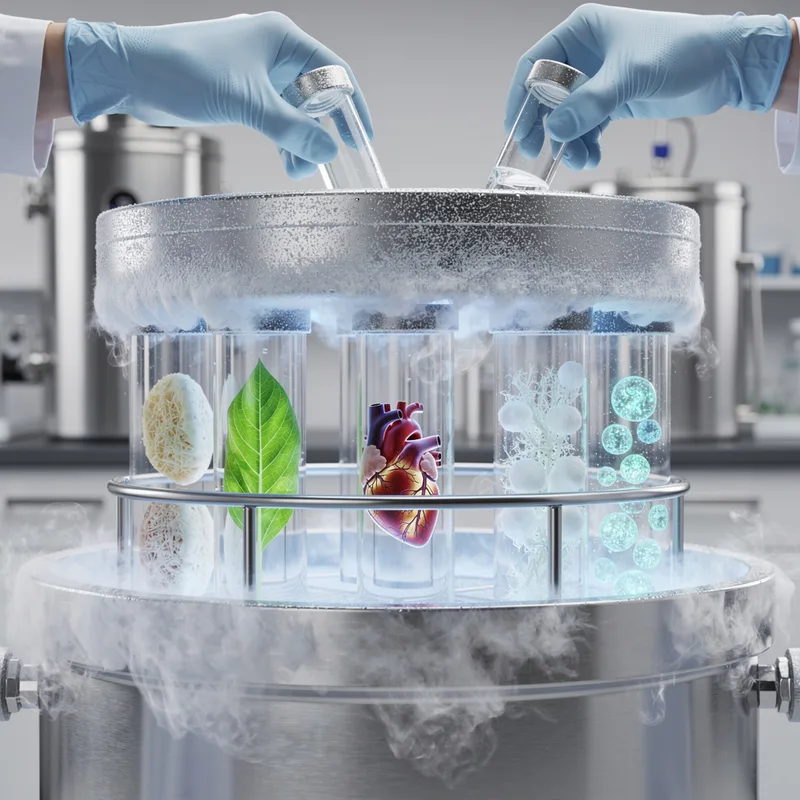
- The process of cryopreservation allows scientists to store living cells at very low temperatures to prevent decay.
- cryopreservation of embryos
Loading YouTube…
Watch on YouTubeUpon a client's death, specialized teams initiate the cryopreservation process promptly to prevent cellular decomposition.
- Upon a client's death, specialized teams initiate the cryopreservation process promptly to prevent cellular decomposition.
Examples
-
Ultra-low-temperature storage—cryopreservation—of swine embryos was developed, enabling unprecedented global transport of embryos.
Academic text (2001) -
As advances in cryopreservation make it more common, the impermanence of female fertility is best confronted at younger ages.
Blog text (23) -
It's because what they have in mind is the cryopreservation of specimens of plants and animals.
-
For women, cryopreservation is not a process that can be undertaken lightly.
Blog text (23) -
Cryopreservation of swine embryos was developed in the 1990s.
Academic text (2001) -
Upon a client's death, specialized teams initiate the cryopreservation process promptly to prevent cellular decomposition.
-
Grapes pose a cryopreservation challenge because typical cryopreservation tactics that work beautifully for other crops don't work for this one.
Academic text (2006) -
For example, the North American Cheetah Survival Plan has financially supported educational outreach and research in Namibia, including sperm collection and cryopreservation.
Academic text (1997) -
Here, cryopreservation specialist Susan Sheffer removes grape buds from storage for regeneration.
Academic text (1999) -
In patients who are of reproductive age, cryopreservation (cooling of tissues or cells to very low temperatures to maintain viability) of their sperm may be recommended.
Academic text (2010)
Synonyms
 15
3.5
15
3.5
Cooling or freezing food to keep it fresh

To cool or freeze food to keep it fresh
How Cold

Surface Forms
Morphology
cryopreservation = preservation (transparent) = cryo + preservation
The meaning follows directly from the combining form 'cryo-' (cold/freezing) applied to 'preservation', indicating preservation by very low temperatures.
Etymology
The word cryopreservation combines cryo- and preserve, where cryo- means 'cold' or 'frost' and preserve means 'to keep'. So cryopreservation is like putting cells in a very cold 'freezer' to keep them from decaying for a long time.