
cosmography


 1
9.9
1
9.9
- noun
- /kɒzˈmɒɡrəfi/
- Specialized
- Understanding cosmography is crucial for mapping the stars and our planet's features.
- cosmography and astronomy
Examples
-
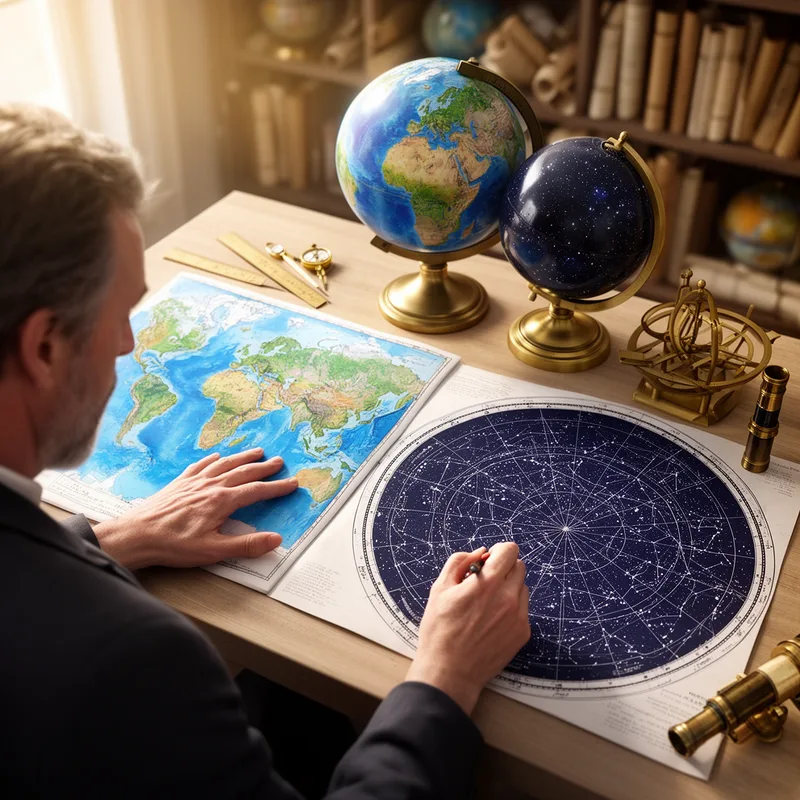
In other words, geography is a branch of science concerned with Earth's landforms, and astronomical geography is commonly known as cosmography.
Academic text (2015) -
The Book of Universal Cosmography attempts to place all universal phenomena in one system.
-
Genesis contains all of astronomy, cosmography, geology, geography, and ethnography.
Fiction book (2002) -
Islamic cosmology and cosmography have served as a matrix for the Islamic sciences, from geography to alchemy.
Academic text (1994) -
The books printed there, both in the original and in Italian translation, covered a broad spectrum of subject matters, from history to agriculture and botany; from astronomy and cosmography to navigation.
Academic text (1994) -
There is a vertical plane in Native American cosmography, but it does not carry the evaluative connotations of "better" vs. "worse" or "good" vs. "evil." Native American cosmography consists of six directions: east, south, west, north, above, and below.
Academic text (2015) -
In school, students learned cosmography to study celestial bodies and Earth's geography.
-
His work in cosmography produced detailed maps of both the universe and terrestrial landscapes.
Surface Forms
Morphology
cosmography = cosmo + graph + y
The word is built from the learned combining form cosmo- and graphy-related material meaning description or mapping, so the general meaning is partly predictable but still technical.
Etymology
Cosmography comes from Greek parts cosmo- meaning 'world' and -graphy meaning 'writing' or 'description', the same cosmo- you see in cosmos and the -graphy you see in geography. So cosmography is like 'writing about the world', which is why it means describing and mapping the Earth and the universe.