

cordgrass


 1
8.9
1
8.9
- noun
- /ˈkɔrdˌɡræs/
- Specialized
- In the wetlands, the cordgrass stabilizes the soil and prevents erosion during storms.
- cordgrass zone
Examples
-
Could be—certainly there's an entrance to something in the cordgrass.
Fiction book (1996) -
Sandworms were most abundant in the sloping part of the intertidal zone between the cordgrass.
Academic text (1990) -
On the images, the cordgrass zone appears light gray to pinkish tan.
Academic text (1999) -
Seas of soft, green salt meadow cordgrass contrast with stiff, dark needle rushes.
Academic text (1998) -
I'll be lucky if I see the one muskrat a friend told me built a lodge in the saltwater cordgrass of Inwood's marsh.
Fiction book (1996) -
Above the shoregrass zone is Gulf cordgrass, and at the upper margin, shrubs grow in water with as little as 5 parts of mineral salts.
Academic text (1999) -
Brackish marsh harbors robust stands of salt marsh cordgrass and seaside bulrush, which grow up to five feet tall.
Academic text (1998) -
Anyhow, a chap can't just kick back in the cordgrass and thumb through a computer disk with his/her bare-assed eye, capisce?
Fiction book (2001) -
On one particular spring day, when the outlying blanket of cordgrass waved in the ocean breeze and the loblolly pine smelled fresh of sap, something extraordinary happened to them.
Fiction book (1999) -
Occurrences of three species are given: + is a high-marsh indicator, Salicornia subterminalis; X is S. virginica; and the third row of symbols under transect is cordgrass, S. foliosa.
Academic text (2001)
Synonyms
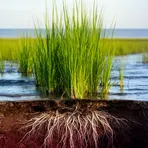
A tall grass that grows in marshes near the sea and helps hold the soil

A group of grasses that grow in freshwater swamps and salt marshes
Compounds
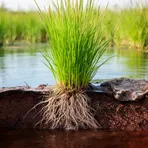
- Specialized
A grass that grows in fresh water wetlands and helps hold the soil

- Specialized
A tall coarse grass that grows in prairies and wetlands and shelters birds and small animals
Surface Forms
Morphology
Etymology
Cordgrass comes from cord, meaning 'rope', and grass. People either used its tough fibers like a rope or noticed its roots and stems 'bind' the soil. That's why cordgrass is so important for holding marsh soil and protecting shorelines.