
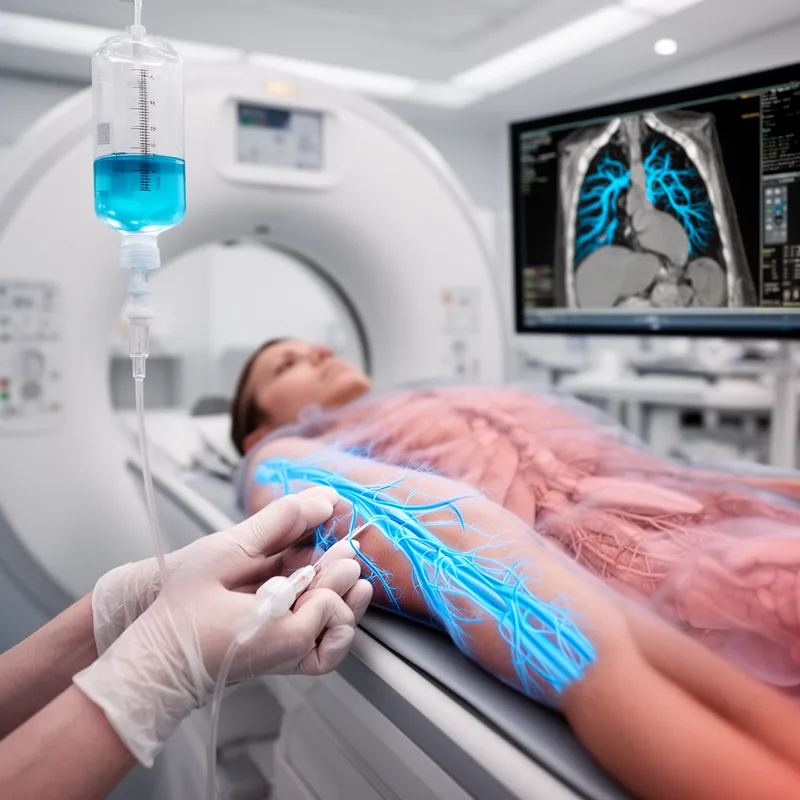
contrast medium
- noun
- /ˈkɒntræst ˈmiːdiəm/
- Specialized
- A myelogram is a radiograph of the spine after an intrathecal injection of a radiopaque water-soluble contrast medium.
- contrast medium for spinal imaging
Examples
-
This procedure involves a lumbar puncture in which a small amount of cerebral spinal fluid is removed and replaced by an iodine-based, water-soluble contrast media.
Academic text (2006) -
DSA allows demonstration of vessels filled with contrast media without the superimposed background structures by subtracting images acquired prior to contrast administration (mask) from images acquired after contrast administration.
Academic text (2007) -
Contrast medium was injected directly into the intervertebral disc.
Academic text (2005) -
The contrast media is the dark column overlying the vertebral bodies and filling the spinal column.
Academic text (2006) -
The white column overlying the vertebral bodies is the contrast media-filled spinal canal.
Academic text (2006) -
Radiography is then used to show extravasation/leakage of contrast medium, which indicates disc herniation.
Academic text (2005) -
Diagnosis is aided greatly by the finding of a drainage site in the direction of the external auditory canal and, if possible, by radiologic investigation with injection of a contrast medium.
Academic text (1998) -
Contrast media outlines the spinal cord, the nerve root bundles, and the edges of the intervertebral disks.
Academic text (2006) -
The white arrows in Figure 9 indicate the spinal cord, with contrast media highlighting the soft tissue in the spinal canal. Note the multiple dark nerve root bundles inside the spinal cord. Compare this contrast image with area "B" in Figure 8, where the spinal cord is not depicted.
Academic text (2006) -
A myelogram is performed by injecting a radiopaque contrast medium into the spine to visualize the spinal canal.
Synonyms


 1
4.4
1
4.4
A liquid dye injected or swallowed to make organs show on scans
How Invasive

Surface Forms
Morphology
The phrase is compositionally interpretable as 'a medium/substance that produces contrast' so a learner who knows the constituents can infer it is some kind of substance that makes differences visible. However, the precise biomedical sense — a substance used in medical imaging that is radiopaque (opaque to x‑rays) — is domain‑specific and not fully predictable from the basic word meanings, so the expression is only partially transparent.
Etymology
Contrast medium comes from the idea that a contrast, a 'difference', is made by a medium, a 'liquid', that makes hidden body parts stand out. Think of it as pouring colored water into pipes so they show up on a picture. That's why a contrast medium is used to make organs or blood vessels visible on scans.