

conic
- noun
- /ˈkɒnɪk/
- Specialized
- If I move and come to this situation, I watch the same five points, I draw the conic and it's a hyperbola.
Examples
-
The basic conic a circle, or really in this case a disk, because it's a filled in circle.
-
So just a note on why are they conic sections?
-
But now we're going to get in into, you know, identifying the conic based on the formula in general form.
-
But our orbit might be some type of hyperbolic section, conic section.
-
And at least in my personal experience from teaching precalculus, conic sections are the hardest thing for students to learn in a precalculus class.
-
Many, many centuries later, Kepler used precisely the ellipse and other conic sections to explain how planets actually go around the sun.
-
So Steiner said, OK, this there should be that many conics tangent to five given conics.
-
Any conic subdivision on the plane is simplicial; therefore, each conic sector has exactly two boundaries (rays) and adjacent sectors.
Academic text (2010) -
In geometry class, we learned about the various types of conic sections, including ellipses and parabolas.
-
The teacher explained that a conic is formed when a plane intersects a circular cone.
Synonyms
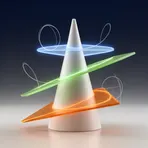
A curve made when a flat surface cuts a cone, like an ellipse, parabola, or hyperbola
Compounds

- Specialized
A mushroom that has a cone-shaped cap with pits attached to the stem, grey when young and black when old

- Specialized
A map that shows the Earth's surface on a cone placed over the globe
- Specialized
A curve made when a flat surface cuts a cone, like an ellipse, parabola, or hyperbola

- Specialized
A type of morel mushroom with a smooth cone-shaped cap and a fragile stalk
Surface Forms
Morphology
Etymology
Conic comes from the old Greek word kōnos 'cone'. In geometry a conic is a curve you get when a flat surface cuts a cone, so ellipses, parabolas and hyperbolas are all types of conic curves.

