
congenator
- noun
- /kənˈdʒɛnəˌtɔr/
- Specialized
- Unlike its congenator, this plant thrives in much drier climates.
Examples
-
The two species of butterflies are considered congenators, as they belong to the same genus and share common ancestry.
-
Biologists often compare genetic traits among congenators to study evolutionary relationships.
-
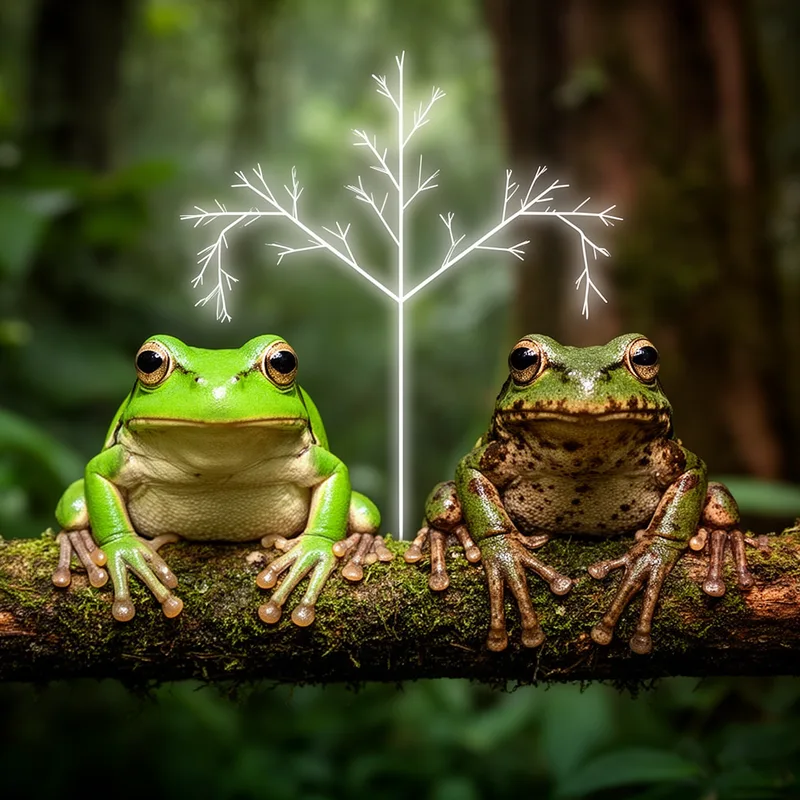
The two frog species are congenators found in different parts of the rainforest.
-
The congenator species share similar traits.
-
Many congenators thrive in similar habitats.
-
In the study of evolution, scientists often research the traits of various congenators to understand their similarities.
-
Researchers discovered that their congenators exhibit greater genetic diversity than previously thought.
Synonyms

 57
4.0
57
4.0

An animal or plant that belongs to the same family as another, for example a dog and a wolf

An animal or plant from the same genus, a small group of closely related species

A thing that is the same kind or closely related to another
Surface Forms
Morphology
congenator = congener (opaque) = con + gener + ator
Although the elements (con- + gener + -ator) are segmentable, the formation is rare and irregular compared with the established noun 'congener', so the meaning is not predictably derived by typical learners.
Etymology
Congenator comes from two parts: con- meaning 'together' and gen- meaning 'birth' or 'origin', the same root you see in gene and generation. So a congenator is an animal or plant that shares the same origin or belongs to the same 'genus' or group.