

to concretize
 1
7.9
1
7.9

- verb
- /kənˈkriːtaɪz/
- US
- To help the students understand the concept better, the teacher used diagrams to concretize the theory.
- the reader can concretize
Loading YouTube…
Watch on YouTubeDo you start to concretize your thoughts on paper?
- Do you start to concretize your thoughts on paper?
- So these individual differences that we think might be concretized and fixed may not be so fixed.
- They could somehow concretize and give form and shape to energy in a way where people could interact with it.
- And once it's concretized, then the child comes out to the parents.
Examples
-
The peace accords also did little to concretize the principle of civilian control over the military.
Academic text (2000) -
How multiscalar social-structural forces and discourses are concretized in space is mediated by social capital and its organizational manifestations.
Academic text (2005) -
Do you start to concretize your thoughts on paper?
-
OK, so again, this is something that I concretize after listening to you, but the idea that shame has its place.
-
There may be moments the researchers can remember that will concretize what I am saying.
Academic text (2003) -
I think actually a more crucial talent is actually the ability to concretize that so much academic writing is abstract, generic.
-
Historians and social scientists can certainly concretize their study (in research projects and local history, for example).
Academic text (1993) -
First, there was a strongly felt need to concretize the faith-inspired quest for social justice in specific political options.
Academic text (1992) -
A child's existence is first concretized in the eyes of the parent.
Fiction book (1996) -
Universities are the birthplace of life-changing ideas and innovations that are further concretized to benefit the rest of humanity.
Academic text (2018)
Synonyms
 21
5.8
21
5.8
To become clear and definite, as an idea or plan
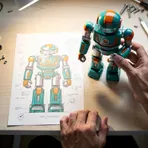 8
7.1
8
7.1
Make an idea or plan become real
 3
9.9
3
9.9
To think of an idea as a real thing
 2
7.4
2
7.4
To make an idea or feeling into a real, visible thing
 2
7.4
2
7.4
To make an idea seem real or clear to others
 1
9.6
1
9.6
To show a general idea by giving a clear example


 1
9.9
1
9.9
To make an idea or feeling into something physical

To treat an idea as if it were a real thing

To make an idea or plan become real and physical
How Concrete

Surface Forms
Morphology
Etymology
Concretize comes from concrete, which means 'solid' or 'real', and the ending -ize, which means 'to make'. So to concretize an idea is to make it 'solid', clear, and specific.