

complementary close
- noun
- /ˌkɒmplɪˈmɛntəri kloʊs/
- Formal
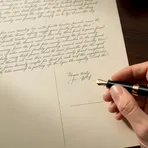
- Every business letter should include a complementary close before the sender's name.
Examples
-
She signed off her letter with a traditional complementary close to show respect.
-
The complementary close should reflect your relationship with the recipient.
-
The teacher explained where to place the complementary close in a formal letter.
-
Please use a complementary close in your letters.
-
Every business letter should include a complementary close before the sender's name.
-
She signed off her letter with a traditional complementary close to show respect.
-
The complementary close should reflect your relationship with the recipient.
Synonyms

 131
1.0
131
1.0

A polite message that gives your good wishes to someone
 8
5.5
8
5.5
A polite closing you write before your name at the end of a letter or email
 3
2.1
3
2.1
A polite way to end a formal letter when you know the person's name
 1
2.3
1
2.3
A polite, friendly way to end a letter or email

It is a friendly word written at the end of a letter before the sender's name

Happening at the end of an event or period
Antonyms


How Formal
- Formal
3
2.1

- Formal
1
2.3
- UK
- Informal
772
1.0
Surface Forms
Morphology
The literal senses of 'complementary' (acting to complete) and 'close' (conclusion) do not directly yield the specialized notion of a conventional polite phrase at the end of a letter; the MWE is a conventional, formulaic term whose meaning is not compositionally obvious. Moreover, orthographic/semantic confusion with the similar term 'complimentary close' (meaning a courteous phrase) increases unpredictability for learners, so a B1 speaker knowing the parts would likely not infer the correct sense.
Etymology
Complementary close: The noun complementary close comes from old letter writing; the word complementary means 'completes' and close means 'end', so it is the polite phrase, like 'Sincerely yours', put just before the signature to show respect.