
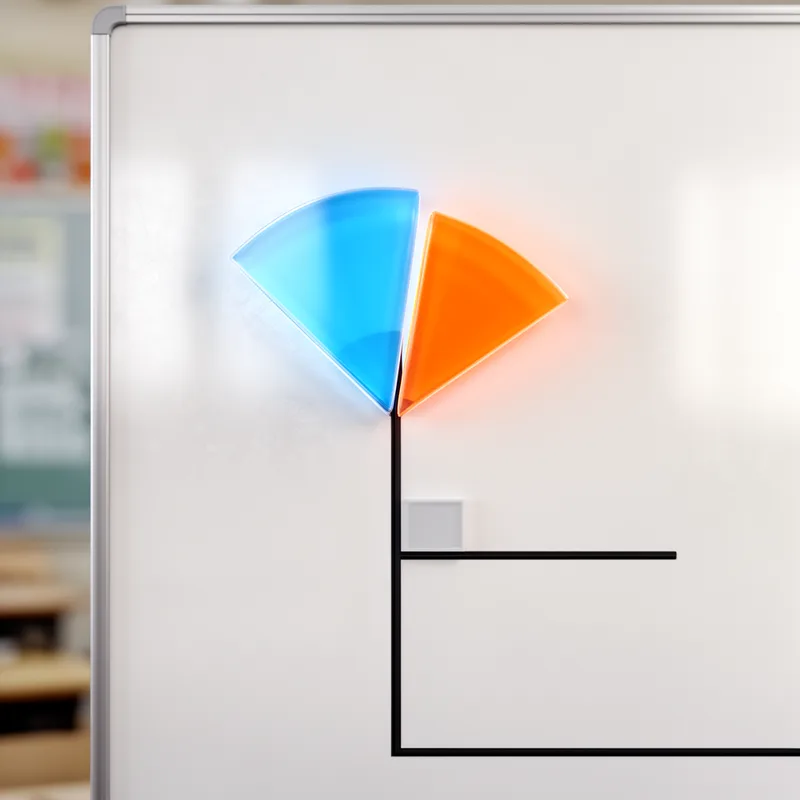
complementary angles
- noun
- /ˌkɒmplɪˈmɛntəri ˈæŋɡlz/
- Specialized
- The two angles formed by a right triangle are always complementary angles, adding up to 90 degrees.
Examples
-
Two complementary angles always add up to 90 degrees.
-
The teacher asked the students to find pairs of complementary angles in the diagram.
-
An angle of 30 degrees and an angle of 60 degrees are complementary angles.
-
If two angles are complementary angles, their measures add up to 90 degrees.
-
Are complementary angles always adjacent?
-
When measuring the two angles, we found that they were complementary angles because their measures summed to exactly 90 degrees.
-
In geometry class, we learned that complementary angles have a special relationship as their total measure equals 90 degrees.
Surface Forms
Morphology
The adjective 'complementary' keeps its core meaning of 'completing' or 'adding to' and combined with 'angle' a B1 learner can infer that the two angles somehow complete one another. However, the specific convention that they add up to exactly 90° is a domain-specific mathematical definition that is not predictable from the ordinary meanings of the constituents alone, so this is only partially transparent.
Etymology
Complementary angles get their name from the idea that one angle 'completes' the other to make a right angle. Think of two pieces that fit to form a corner, and that's why complementary angles add up to 90 degrees.

