

common foxglove
- noun
- /ˈkɒmən ˈfɒksˌɡlʌv/
 :
digital común
:
digital común
- The leaves of the common foxglove are a vital source for the heart medication digitalis.
Examples
-
Farmers are cautious about common foxglove because its leaves can be poisonous to sheep and cattle.
-
The common foxglove grows in many gardens.
-
The garden was full of common foxglove, its tall spires covered in vibrant purple blossoms.
-
I saw a beautiful common foxglove in the park.
-
The common foxglove is well-known for its beautiful clusters of pink-purple flowers.
-
Many gardens feature the common foxglove for its striking appearance in the summer.
-
When planted in the right conditions, the common foxglove can thrive and reach impressive heights.
Synonyms

 6
8.2
6
8.2

A tall plant with bell-shaped purple flowers that are poisonous
 1
9.3
1
9.3
A tall garden plant with long spikes of bell shaped flowers called foxglove

A tall European plant with purple bell-shaped flowers whose leaves make a medicine for the heart and are poisonous

A tall leafy plant with large pink-purple flowers that has leaves poisonous to livestock and used for heart medicine

A tall garden plant with large pink-purple tube-shaped flowers and leaves poisonous to animals

A tall plant with large pink-purple tube flowers whose leaves are poisonous but make heart medicine
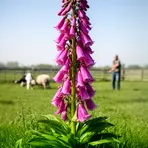
A tall plant with clusters of large pink-purple tube-like flowers and leaves poisonous to farm animals
Surface Forms
Morphology
This is a straightforward adjectival modification: 'common' (typical/frequently occurring) + 'foxglove' (the plant) yields 'the typical or usual foxglove species'. The meaning is directly compositional and follows a common ADJ+N pattern found across languages, so a B1 learner who knows both words will understand it.
Etymology
Common foxglove may come from an old phrase 'folk's glove' because people thought the bell-shaped flowers looked like tiny gloves for 'fairies'. Over time 'folk' became the word fox, so the plant was called foxglove, even though its leaves are 'poisonous' and are also used to make heart medicine.