

common fault
- noun
- Specialized
 :
falla normal
:
falla normal
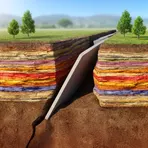
- The diagram illustrates how the hanging wall in a common fault slips downward relative to the footwall.
Examples
-
Geologists identified a common fault running through the valley, indicating significant tectonic movement.
-
The common fault in this area is well-documented.
-
A common fault is often associated with areas where the crust is being pulled apart.
-
Many geologists study the common faults in the region.
-
A common fault is often associated with areas where the crust is being pulled apart.
-
Geologists identified a common fault running through the valley, indicating significant tectonic movement.
-
The diagram illustrates how the hanging wall in a common fault slips downward relative to the footwall.
Synonyms


 1
7.0
1
7.0
A sloping break in the Earth's crust where the upper side moves down past the lower side

A sloping break in rock where the upper block moves down because of its weight
Surface Forms
Morphology
While 'common' + 'fault' might be interpreted by a learner as 'a fault that is frequent or ordinary', the given definition specifies a precise geological orientation (hanging wall moved downward) that is a technical sense not derivable from the constituent meanings. A B1 learner who knows 'common' and 'fault' would not be able to predict this specialized structural meaning without prior exposure.
Etymology
Common fault may come from a simple rock picture: one block called the hanging wall slips down beside the lower footwall, like a step falling. So the name describes a fault where the upper block has moved 'down' compared with the lower block.